

Dubai is more than just a glamorous destination—it’s a global business powerhouse that attracts ambitious entrepreneurs from around the world. Whether you’re an investor from Europe, a startup founder from India, or a consultant based in the U.S., the opportunity to establish a business in Dubai is now more accessible and rewarding than ever before.
Due to its investor-friendly regulations, zero-income tax policy, advanced infrastructure, and thriving multicultural market, Dubai has become a magnet for international business ventures.
But how exactly do you incorporate a business in Dubai? What are the prerequisites, costs, and steps involved?
In this comprehensive guide, we’ll walk you through everything you need to know about Dubai company registration—from choosing the right structure to setting up your office and securing a trade license. Let’s dive in.
Why register a company in Dubai?
Dubai has evolved from a desert trade outpost into a global business hub. With over 300,000 active businesses and a GDP exceeding AED 490 billion, the emirate is a powerhouse for trade, logistics, tech, finance, and tourism.
Here are a few compelling reasons to consider company registration in Dubai:
- 100% foreign ownership is permitted in several areas, particularly in free zones.
- 0% personal and corporate income tax in most circumstances.
- Strategic location connecting Asia, Europe and Africa
- Ranked among the top 20 easiest countries to do business (World Bank)
- Fast-track visa and residency options for entrepreneurs and employees
- Stable political and economic environment
- No currency restrictions or limits on profit repatriation
Whether you’re a startup founder or an established firm, incorporating a company in Dubai offers long-term advantages with global reach.
Types of Companies in Dubai
Before you begin with company formation in Dubai, you must decide on the legal structure.
Here’s an in-depth look at the major types of companies you can form in Dubai:
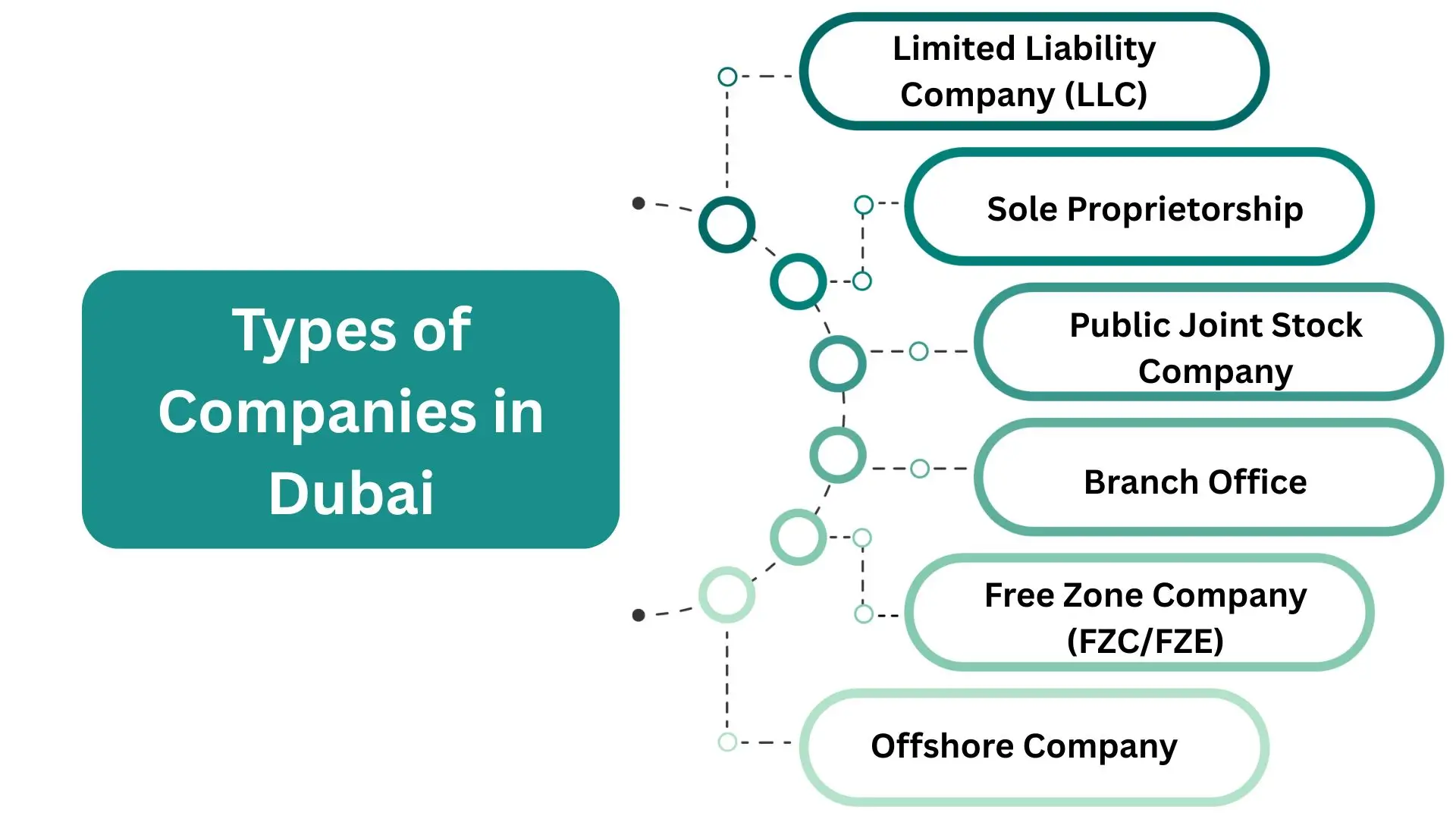
1. Limited Liability Company (LLC)
- An LLC in Dubai is the most common for a mainland business setup
- Requires 1–50 shareholders
- Ideal for trading, contracting, and services
- Now allows 100% foreign ownership for most activities
2. Sole Proprietorship
- Owned by a single person
- Suitable for professionals such as consultants, designers, etc.
- No limited liability protection
3. Public Joint Stock Company
- Requires at least AED 30 million in capital
- Shares can be listed on stock exchanges (e.g., DFM)
4. Branch Office
- Extension of an international business
- Can carry out commercial activities in Dubai
- Requires a local service agent
5. Free Zone Company (FZC/FZE)
- Operates in designated zones like DMCC, IFZA, DSO
- 100% foreign ownership, 0% import/export duties
- Cannot directly trade in the mainland without a distributor
6. Offshore Company
- No physical presence or operations within the UAE
- Ideal for asset holding, international business, and tax planning
- Examples: JAFZA Offshore, RAK ICC
Read More: Offshore Company Formation in Dubai
Company Name Registration in Dubai
Your business name is one of the first things you must finalize during company setup in Dubai.
Key Guidelines:
- The name must not include offensive or religious terms
- It should reflect your business activity
- Avoid using abbreviations of your name (e.g., “A.J. Enterprises” is not allowed)
- For professional firms, personal names are allowed (e.g., “John Smith Legal Consulting”)
Once authorized, the name is reserved in your licensing application. OnDemand International can help check availability and reserve it quickly to avoid delays.
How to Open a Company in Dubai?
The process of company formation in Dubai is discussed below:
Step 1: Determine the Type of Company
The first stage for Dubai company registration is to decide the type of company you wish to form. You can choose from several options, such as a Limited Liability Company (LLC), Free Zone Company, Branch Office, or Representative Office.
Step 2: Choose a Business Activity
After deciding on the type of firm, you must choose the business activity. It is essential to select the right activity, as certain activities may require special licenses or external approvals (e.g., from the Dubai Health Authority or Central Bank).
Step 3: Choose a Company Name
Select a unique name for your organization that reflects its activities. It must follow the UAE’s name regulations and not include offensive or religious terms.
You can check the availability of the name on the Department of Economic Development’s (DED) website or with the relevant Free Zone Authority.
Step 4: Obtain Initial Approval
Submit your initial application for approval with the selected authority (DED for mainland or Free Zone for FZC/FZE). This includes your proposed company name, selected business activity, and passport copies of shareholders.
Step 5: Prepare the Memorandum of Association (MOA)
Prepare and notarize the Memorandum of Association (MOA), which outlines the company’s structure, shareholder roles, capital distribution, and operational objectives. Some structures may also require a Local Service Agent agreement.
Step 6: Obtain Office Space
For a mainland company, having a physical office address is necessary. For Free Zone entities, you can select from various packages, including virtual offices, flexi-desks, or dedicated office space, depending on your business needs and visa quota.
Step 7: Obtain a Trade License
Apply for a trade license by submitting all verified documents, including the MOA, the tenancy contract (Ejari), and the initial approval certificate. Your business activity determines the sort of trade license you require.
- Commercial License – For trading companies
- Professional License – For service-based companies
- Industrial License – For manufacturing or industrial activities
Step 8: Enroll with the Chamber of Commerce
After your license is issued, you must register your business with the Dubai Chamber of Commerce to receive your membership certificate, which may be required for certain operations, banking, or tendering processes.
Step 9: Apply for Visas and Establishment Card
Apply for your investor visa and employee visas as required. You’ll also need to obtain an Establishment Card from the Ministry of Human Resources and Emiratisation (MOHRE) for visa processing and labor file creation.
Step 10: Open a Corporate Bank Account
With your trade license and company documents, open a business bank account in the UAE. Banks like Emirates NBD, Mashreq, RAKBANK, and ADIB offer tailored accounts for SMEs, startups, and international companies.
Is It Possible to Form a Company Online in Dubai?
Yes. Dubai’s digitization makes it easy to open a company remotely. This is particularly useful for foreign investors.
Online Setup Includes:
- E-signature approval and document uploads
- Online fee payments
- Virtual office packages
- Remote account opening (subject to KYC)
Free zones such as IFZA and Meydan allow 100% digital incorporation in under 3–5 days.
Documents Needed for Company Registration in Dubai
For Individuals:
- Passport copy (valid minimum of 6 months)
- Passport-sized photographs (with white background)
- Address proof (utility invoices or bank statement)
- CV or business plan (for certain licenses)
For Corporate Shareholders:
- Certificate of Incorporation
- Memorandum and Articles of Association
- Board resolution authorizing the company’s setup
- Shareholder passport copies
Benefits of Opening a Company in Dubai as a Foreigner
Foreign investors benefit immensely from Dubai’s liberal economic policies and modern business environment. Here’s why:
1. Full Ownership in Free Zones
Previously, foreigners required a local sponsor for mainland ventures. Now, many activities permit 100% ownership, enabling greater control over operations and profits.
2. Residency Visa for You and Your Family
Setting up a company allows the entrepreneur, their dependents, and employees to apply for UAE residency visas, simplifying long-term relocation and business management.
3. Repatriation of Capital and Profits
There are no limitations on transferring capital and profits outside the UAE, making it ideal for global investors.
4. Tax Optimization
With no personal income tax and newly introduced corporate tax only applying in specific circumstances (9% after AED 375,000 profit), foreign businesses benefit from tax efficiency.
5. Supportive Ecosystem
Dubai boasts accelerators, networking events, co-working spaces, and investment funds, especially beneficial for tech startups and SMEs.
Cost of Company Registration in Dubai
The cost of setting up a company in Dubai varies based on your chosen jurisdiction (mainland, free zone, or offshore), number of shareholders, visa requirements, as well as office address preferences.
Here’s a breakdown of estimated startup costs in AED:
| Company Type | Cost Range (AED) | What’s Included |
| Free Zone Company | 12,500 – 25,000 | Business license, registration, virtual/shared office, up to 3 visa quotas |
| Mainland Company | 18,000 – 35,000 | DED license, tenancy contract, trade name reservation, agent services |
| Offshore Company | 10,000 – 18,000 | Incorporation certificate, registered agent, legal documentation |
Additional Costs to Consider:
- Investor visa fees: AED 3,500–7,000 per person
- Bank account opening assistance: AED 1,500–3,000 (optional)
- Office rent (Mainland): Varies significantly depending on the location and size
These expenses are approximate and differ based on the business activity, free zone selected, and service providers.
Top Business Sectors in Dubai
Dubai’s dynamic economy offers abundant opportunities for aspiring entrepreneurs across various industries. The government’s forward-thinking initiatives, world-class infrastructure, and favorable tax regime make it the ideal place to launch or scale your business.
Here are the top-performing business sectors to consider in 2025:.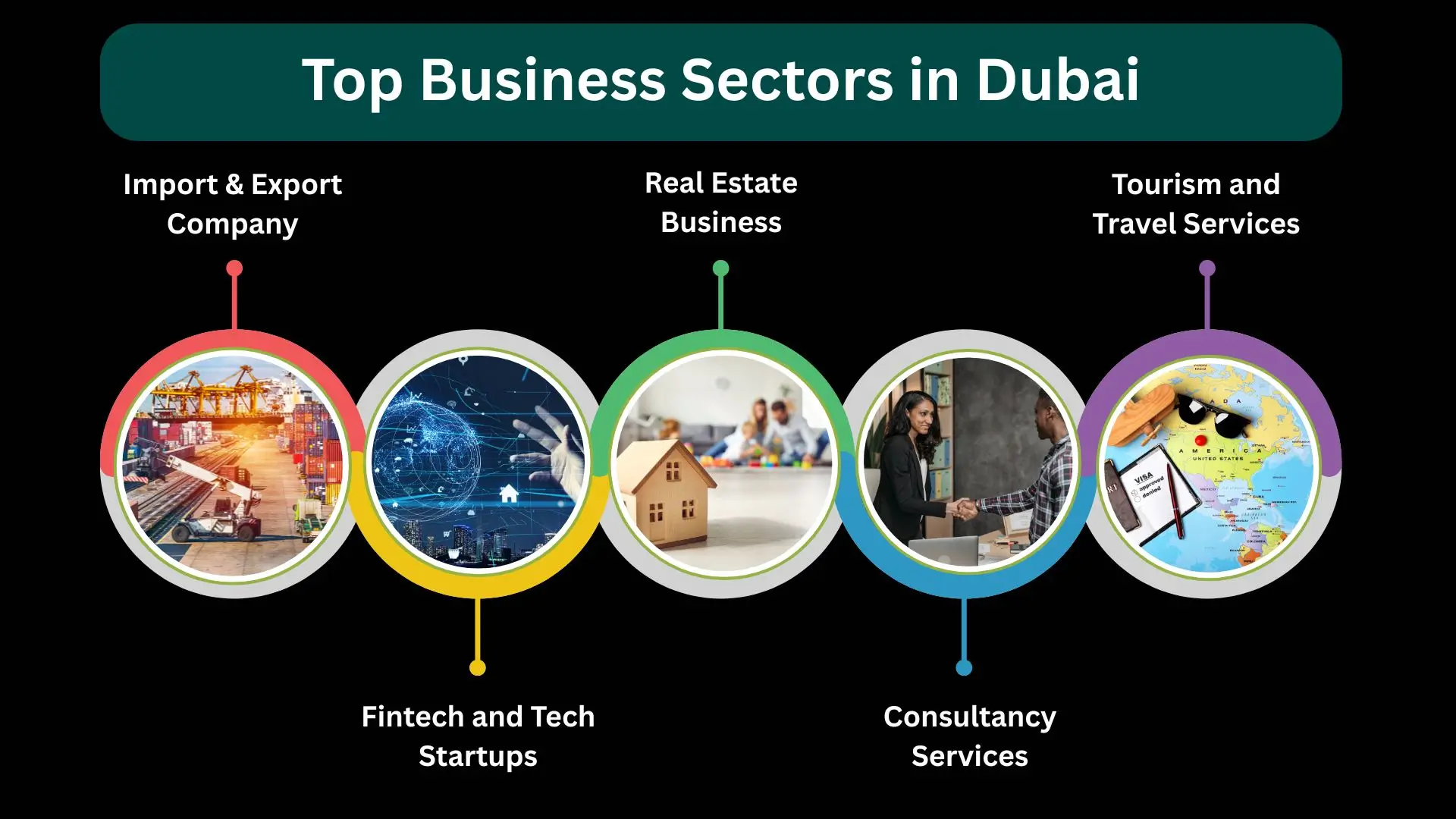
1. Import & Export Company
Due to strategic geographic positioning and top-tier port facilities (Jebel Ali Port), Dubai serves as a vital link in global trade. Trading companies in electronics, luxury goods, auto parts, and food products perform exceptionally well.
2. Fintech and Tech Startups
With growing investments in blockchain, AI, and cybersecurity, Dubai’s fintech ecosystem is booming. Initiatives like DIFC Innovation Hub and government grants encourage global startups to thrive here.
3. Real Estate and Property Management
Dubai’s real estate remains lucrative due to rising demand for commercial and residential spaces. Property management, brokerage, and short-term rental businesses offer high ROI.
4. Consultancy Services
Foreigners with professional expertise are setting up consultancies in legal, HR, IT, sustainability, and business strategy. These are low-overhead, high-profit ventures.
5. Tourism and Travel Services
With millions of tourists annually and upcoming mega-events, travel agencies, tour operators, and experience-based businesses (luxury desert safaris, cruises, etc.) are gaining traction.
Free Zones in Dubai
Dubai features over 30 free zones, each designed to accommodate specific industries with tailored infrastructure, simplified licensing procedures, and business-friendly environments.
Here’s a look at some of the most prominent free zones in Dubai:
DMCCCommodities, Crypto, TradeAward-winning, central location, extensive business support
| Free Zone | Primary Focus | Key Advantages |
| Dubai South | Logistics, Aviation | Adjacent to Al Maktoum International Airport and Expo 2020 site |
| IFZA | Services, SMEs | Competitive pricing, fast digital setup, wide range of business activities |
| Dubai Internet City | Tech, Media, IT | Tech cluster housing Google, Microsoft, Meta; excellent infrastructure |
| Dubai Healthcare City | Healthcare, Wellness | Licensed by Dubai Health Authority; ideal for clinics, labs, and wellness brands |
| Meydan Free Zone | General Businesses | Digital onboarding, Flexi-desk options, 100% ownership, no mandatory office |
All free zones offer:
- Complete foreign ownership
- 0% corporate and income taxes
- Full repatriation of profits and capital
- No currency restrictions
How OnDemand International Can Assist?
OnDemand International is your one-stop partner for company registration in Dubai. With years of experience, we simplify every step of your entrepreneurial journey.
Our Services Include:
- Business activity and jurisdiction advisory
- Name reservation and documentation support
- License processing and approvals
- Virtual and physical office setup
- Visa application and PRO services
- Bank account opening and compliance assistance
Conclusion
Dubai remains one of the most attractive jurisdictions in the world for establishing a business. With favorable tax laws, liberal foreign ownership rules, and cutting-edge infrastructure, entrepreneurs across the globe are turning their eyes to the UAE.
From choosing the right structure to getting your trade license and bank account sorted, the process doesn’t have to be overwhelming, especially with OnDemand International by your side.
Contact our incorporation experts today.
FAQ’s
Can a foreigner completely own a business in Dubai?
Yes, foreigners can fully own companies in many free zones and across various sectors in mainland Dubai, especially after recent reforms that eliminated the mandatory local sponsor requirement for most business activities.
What is the minimum capital requirement to start a business in Dubai?
Most free zones and LLCs in Dubai do not have a mandatory minimum capital deposit. However, some legal structures like Joint Stock Companies may require capital starting from AED 5 million.
Can I set up a business in Dubai without visiting the UAE?
Yes, several free zones offer 100% remote registration services, including digital signatures and virtual office packages, making it possible to set up your company from abroad.
Do I need an office space to register my business in Dubai?
Yes. Mainland businesses must rent a real office. Companies in free zones can choose between flexi-desks, shared workspaces, and virtual offices based on their visa and operating requirements.
How much does it cost to renew a business license annually?
Annual renewal costs vary by free zone and business type but typically range from AED 8,000 to AED 15,000. Additional expenses may apply for visa renewals as well as office lease renewals.