


Introduction
British entrepreneurs can start a business in Canada by incorporating a subsidiary corporation through Corporations Canada — a process that typically takes 5–7 business days.
With its stable economy, low corporate tax rates, transparent regulations, and world-class infrastructure, Canada offers British entrepreneurs a unique gateway to scale their businesses internationally.
Unlike other destinations, Canada maintains close cultural and trade ties with the UK, making it easier for British investors to transition into the Canadian market while benefiting from favorable immigration pathways such as the Start-Up Visa and Intra-Company Transfer Program.
Canada is not just a dream opportunity; it’s one of the most accessible and rewarding countries for UK entrepreneurs to incorporate a company abroad. Whether you are planning to expand your existing business operations or set up a brand-new venture, Canada provides the right blend of security, growth potential, and global connectivity.
In this comprehensive guide, you’ll learn exactly how to start a business in Canada from the UK—including the best business structures, step-by-step incorporation process, legal requirements, taxation, and visa options designed specifically for British entrepreneurs.
Why Canada is the Best Choice for UK Entrepreneurs?

1. Strong UK–Canada Business Ties
- The UK and Canada share a strong trade relationship, reinforced by the UK–Canada Trade Continuity Agreement (TCA).
- UK businesses expanding to Canada benefit from reduced tariffs and cross-border investment protection.
- Shared language and cultural familiarity make market entry easier.
2. Business-Friendly Environment
- Canada ranks among the top destinations for ease of doing business.
- Corporate tax rates are competitive (approx. 15% federal + provincial rates).
- Transparent regulations and strong intellectual property protections.
3. Access to Global Markets
- Through the USMCA Agreement, companies in Canada can trade duty-free with the USA and Mexico.
- As part of the CPTPP, Canadian businesses gain access to 500+ million global consumers.
4. Favorable Immigration for Entrepreneurs
- Start-Up Visa Program: Ideal for British entrepreneurs launching innovative businesses.
- Intra-Company Transfer Visa: Relocate UK executives to manage Canadian subsidiaries.
Business Structures for UK Entrepreneurs in Canada
As a UK entrepreneur, you can choose from multiple business structures depending on your expansion strategy.
Here are the best business structures for British entrepreneurs in Canada:
| Business Structure | Key Features |
|---|---|
| Corporation | Separate legal entity, limited liability, taxed independently |
| Partnership | Two or more partners share profits & responsibilities |
| Sole Proprietorship | Simple to incorporate, but no liability protection |
| Subsidiary Company | A Canadian-incorporated company owned by the UK parent |
| Branch Office | Extension of the UK parent company; not a distinct legal entity |
| Representative Office | Cannot conduct direct business; only for market research, liaison, and networking |
Steps to Start a Business in Canada from the UK

Step 1: Select a Business Structure
Select the entity type that best fits your expansion strategy:
- Subsidiary Corporation – Most popular for UK entrepreneurs; offers limited liability and tax advantages.
- Branch Office – Direct extension of your UK company; higher liability risks.
- Representative Office – Ideal for market research; not permitted to trade.
In most cases, incorporation (subsidiary in Canada) is the preferred choice for UK businesses due to liability protection, credibility, and access to incentives.
Step 2: Decide Federal vs. Provincial Incorporation
| Incorporation Type | Benefits | Considerations for UK Businesses |
|---|---|---|
| Federal Incorporation | Operate across Canada; nationwide brand protection | Requires extra provincial registrations |
| Provincial Incorporation | Register in one province (e.g., Ontario, British Columbia) | Ideal for region-specific operations |
For UK entrepreneurs aiming for nationwide growth, federal incorporation is recommended.
Read More: Federal vs Provincial Incorporation in Canada
Step 3: Register YStep 3: Run Your NUANS Name Search
Before incorporating, conduct a NUANS (Newly Upgraded Automated Name Search) to confirm your chosen company name is unique across Canada. This is mandatory for federal incorporation.
- Run the search via the Corporations Canada NUANS portal or through a registered agent.
- The NUANS report is valid for 90 days from the date of issue.
Step 4: File Articles of Incorporation & Obtain Your Business Number (1–5 business days)
- File your Articles of Incorporation online at Corporations Canada — federal incorporation costs CAD $200 online or $250 by paper filing.
- Once approved, the Canada Revenue Agency (CRA) automatically issues a 9-digit Business Number (BN) used for corporate tax, payroll, and GST/HST accounts.
- UK entrepreneurs without a Canadian address should appoint a registered agent or nominee director at this stage to satisfy the registered office requirement.
Director residency note: A minimum of 25% of directors must be Canadian citizens in order for a company to be federally incorporated. Consider incorporating in British Columbia, Quebec, Nova Scotia, or Prince Edward Island if you don’t have any Canadian directors. These states permit 100% foreign ownership and don’t require directors to reside in Canada.
Step 5: Open a Canadian Business Bank Account
For financial transactions and CRA tax compliance, a corporate bank account is necessary. For UK business owners without a presence in Canada, this is frequently the most difficult phase.
Options for UK entrepreneurs without a Canadian resident director:
- RBC, TD, Scotiabank — require in-person verification and typically at least one Canadian resident director
- Wise Business Account — multi-currency (GBP/CAD), available to UK-incorporated companies with Canadian subsidiaries
- Airwallex — popular with UK companies expanding abroad; supports CAD accounts
- HSBC Canada — may allow remote account opening for existing HSBC UK business clients
- Mercury — US-based but accepts Canadian corporations; good for businesses also targeting the US market
Tip: Appoint a Canadian nominee director to satisfy bank residency requirements while you establish a local presence. Compare GBP–CAD conversion rates before transferring initial capital.
Step 6: Register for GST/HST (if applicable)
If your yearly Canadian revenue exceeds CAD $30,000, you are legally required to enroll for GST/HST.
- Register through your CRA My Business Account portal using your Business Number.
- GST rate: 5% (federal). HST varies by province: Ontario 13%, Nova Scotia 15%, British Columbia 12%.
Legal Requirements to Set up a Company in Canada for British Entrepreneurs
To incorporate in Canada from the UK, you will need the following documents and registrations:
- Articles of Incorporation (federal or provincial)
- Registered Canadian office address (a physical address, not a PO Box)
- NUANS Name Search Report (valid for 90 days)
- Certificate of Incorporation
- Business Number
- Two valid government-issued IDs
- Corporate tax registration
- GST/HST registration (if annual revenue exceeds CAD $30,000)
Taxation for UK Entrepreneurs in Canada
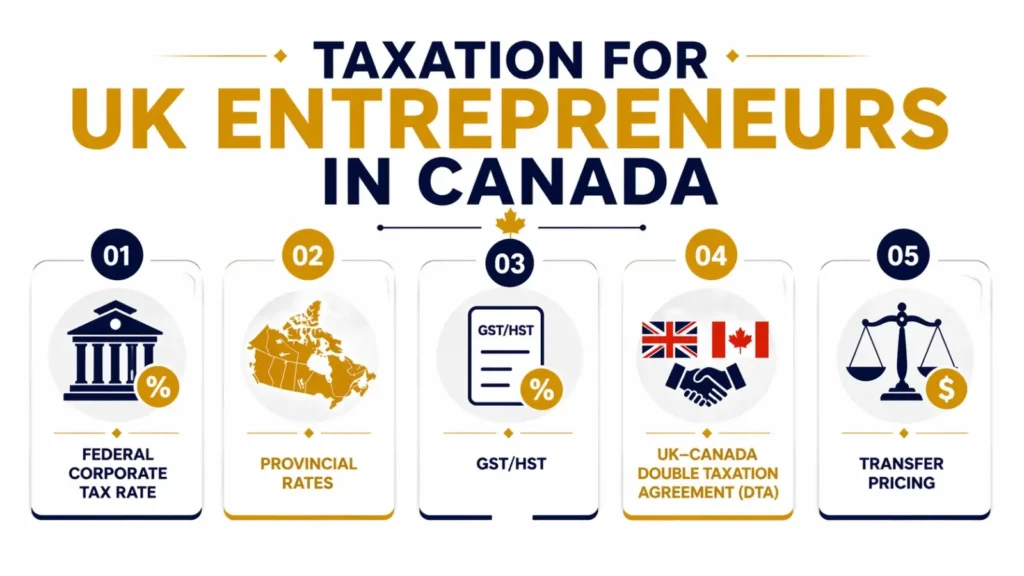
British entrepreneurs operating a Canadian subsidiary are subject to Canadian corporate tax on Canadian-sourced income. Key points:
- Federal corporate tax rate: 15% (small business deduction reduces this to 9% on the first CAD $500,000 of active business income)
- Provincial rates: 8%–11.5% depending on province. Combined effective rate: 23–26.5%
- GST/HST: 5%–15% on taxable supplies, register when annual Canadian revenue exceeds CAD $30,000
- UK–Canada Double Taxation Agreement (DTA): Prevents the same earnings from being taxed in both nations. Dividends paid from a Canadian subsidiary to a UK parent company are generally subject to a 5% withholding tax under the treaty. See: HMRC UK–Canada DTA
- Transfer pricing: If your UK parent charges management fees or royalties to its Canadian subsidiary, both HMRC and CRA require these to be set at arm’s length pricing. Document this carefully.
Professional advice: UK–Canada cross-border structuring isn’t just about tax rates—it’s about aligning two regulatory systems without triggering compliance risks. One wrong move can cost you in double taxation, withholding leaks, or transfer pricing exposure.
Speak to our compliance team before you lock your structure.
Costs of Incorporating a Business in Canada for British Entrepreneurs
| Expense Type | Estimated Cost (CAD) | Notes for UK Entrepreneurs |
|---|---|---|
| Federal Incorporation | $200–$300 | Online via Corporations Canada |
| Provincial Incorporation | $350–$500 | Varies by province |
| NUANS Report | $13–$75 | Mandatory for name approval |
| Legal & Professional Fees | $1,000–$3,000 | Incorporation support, tax setup, and compliance |
| Bank Account Setup | Varies | Some banks require deposit minimums |
Conclusion
Expanding your UK business to Canada is a great choice for you if you are looking for international growth. With its stable economy, trade access to North America, and investor-friendly policies, Canada provides an incredible launchpad for British entrepreneurs.
At OnDemand International, we specialize in helping UK entrepreneurs navigate the entire incorporation process—from NUANS search and incorporation filings to bank account opening and compliance.
Ready to expand from the UK to Canada?
Contact us today and let our experts handle the legal, tax, and business setup—so you can focus on scaling your success.
FAQ’s
How long does it take to register a business in Canada from the UK?
Federal incorporation typically takes 5–7 business days when filed online via Corporations Canada. Provincial incorporation timelines vary: British Columbia processes in 2–5 days; Ontario takes 5–10 business days. Obtaining your Business Number from CRA is usually automatic upon incorporation approval.
Can I start a business in Canada from the UK without moving?
Yes. Many provinces allow 100% foreign-owned companies with no requirement for the owner to be physically present in Canada. British Columbia, Quebec, Nova Scotia, and Prince Edward Island are the most popular choices for UK entrepreneurs because they have no Canadian director residency requirement. You will, however, need a registered Canadian office address and may benefit from a nominee director for banking purposes.
Are UK–Canada profits double-taxed?
No. The UK–Canada Double Taxation Agreement (DTA) ensures the same income is not taxed in both nations. Dividends paid from your Canadian subsidiary to your UK parent company are generally subject to a 5% withholding tax under the treaty (rather than the standard 25%). A cross-border tax adviser can help structure profit repatriation efficiently.
Do I need a Canadian director to incorporate in Canada?
For federal incorporation, a minimum of 25% of directors must be Canadian residents. However, several provinces — including British Columbia, Quebec, Nova Scotia, and Prince Edward Island — allow 100% foreign-owned companies with no residency requirement for directors.
What is the cheapest province to incorporate in for UK entrepreneurs?
Federal incorporation costs CAD $200 online and is the most cost-effective option for businesses planning to operate across multiple provinces. For single-province operations, British Columbia (approx. CAD $350) and Nova Scotia offer the most flexible rules for foreign-owned companies alongside competitive registration fees.
Can a Canadian firm be owned by a UK limited company?
Indeed. A Canadian subsidiary company may be fully owned by a UK Ltd. Because the subsidiary is regarded by Canadian law as a distinct legal entity, the UK parent’s responsibility is restricted to the amount it invested in the Canadian business. According to the Double Taxation Agreement, this arrangement also permits profits to be returned to the United Kingdom.
What is a NUANS report, and is it necessary?
A report from NUANS (Newly Upgraded Automated Name Search) verifies that your suggested business name is distinct throughout Canada and does not clash with already-registered companies or trademarks. All federal incorporations and the majority of provincial incorporations require it. The report is valid for ninety days and costs between CAD $13.80 (self-serve) and CAD $75 (via agent).