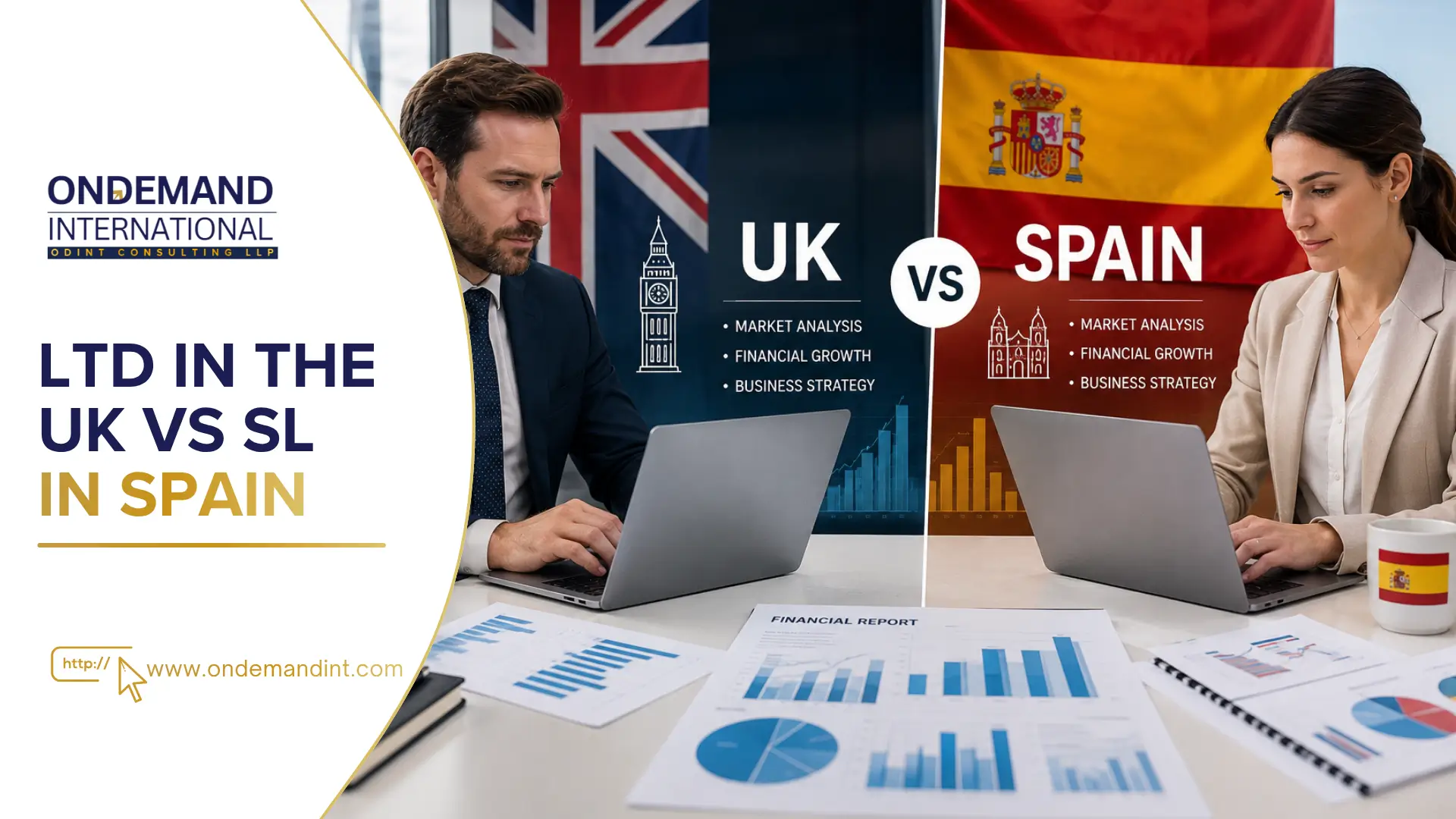

Legal structure is one of the most important decisions in business, especially when beginning or growing a business worldwide. When comparing LTD in the UK vs SL in Spain, entrepreneurs often evaluate two of Europe’s most popular company types: establishment of a private limited company (LTD) in the United Kingdom and a sociedad limitada (SL) in Spain.
They are comparable in terms of limited liability and recognised corporate structure, but they are very different in terms of formation, taxation, compliance, availability, and applicability to foreign entrepreneurs. This guide clarifies the difference in clear and practical terms that help founders select a structure that suits the business model best.
Understanding a UK Private Limited Company (LTD)
A UK LTD is an independent legal entity and subject to UK company law. It is free to own properties, sign contracts, and incur liabilities without reference to its shareholders.
The UK has developed a very digital and business-friendly environment, and the incorporation is to be fast, easily accessible, and flexible, particularly for foreign founders and online businesses.
Key characteristics include the following:
- No minimum capital requirement for shares.
- Fast online incorporation
- None of the nationality or residency limitations.
- Easy compliance and reporting.
- Good international fame and legal security.
UK Ltds are typically used by consultants, digital entrepreneurs, technology startups, international traders, and holding firms.
Understanding a Spanish Sociedad Limitada (SL)
A Spanish SL is the typical Spanish limited liability company, and it is subject to Spanish commercial law. It is closely integrated with Spain’s tax, labour, and social security systems.
The Spanish system is more focused on legal formality, institutional controls, and regulatory compliance. This is suitable for businesses that have a physical presence in Spain or those that mostly operate in the EU.
Key characteristics include the following:
- Minimum share capital requirement of €1.
- Incorporation by notarial and registry.
- Spanish accounting and tax compliance.
- Connecting with labour and social security systems.
- Complete entry to the internal market of the EU.
SLs are commonly used by businesses with Spanish employees, offices, or customers.
Key Differences: LTD in the UK vs SL in Spain
| Feature | UK LTD (Private Limited Company) | Spanish SL (Sociedad Limitada) |
|---|---|---|
| Legal System | Governed by UK company law | Governed by Spanish commercial law |
| Incorporation Method | Online incorporation | Notary + Mercantile Registry registration |
| Time to Incorporate | 1–2 business days | 1–3 weeks |
| Minimum Share Capital | None or nominal (£1) | €1 paid-in capital |
| Corporate Tax | UK corporation tax on profits | Spanish corporate tax; dividend withholding tax |
| Market Access | Post-Brexit: outside the EU single market | Full EU market access |
| Social Security | Only if employing staff | Mandatory for resident directors/employees |
| Accounting & Compliance | Annual accounts + confirmation statement; simplified | Stricter accounting, frequent reporting, labour & social security filings |
Formation and Setup
UK LTD can be established entirely online with low cost and minimal documentation. They do not necessarily need a physical presence, and most of the companies are operational within a few days of business.
A Spanish SL will need notarised documents, registration at the Mercantile Registry, and evidence of paid-in share capital. It is typically more administratively intensive and includes physical appointments and the Spanish-language legal documents.
The UK provides a more efficient set-up process to founders who prefer speed and simplicity.
Capital Requirements
The UK does not impose a formal minimum share capital requirement. A company can be formed with £1 or even without meaningful paid-in capital, allowing founders to preserve liquidity.
Spain needed a minimum share capital of €3,000 for an SL. This sum should be deposited before incorporation and cannot be withdrawn freely to spend on personal use.
This difference is important to startups and small businesses that are required to handle cash carefully during the startup period.
Tax Environment
The profits of UK Ltds are liable to UK corporation tax. Dividend taxation varies according to the country of residence of the shareholder and any existing tax treaties.
Spanish SLs are liable to Spanish corporate tax and dividend withholding tax. Directors resident in Spain are also normally needed to enroll with the Spanish social security service and make monthly contributions.
An important concept is tax residence. Having a UK LTD managed and controlled in Spain, the Spanish authorities may consider it a Spanish tax resident company, no matter its incorporation location.
Accounting and Compliance
UK Ltds have relatively light compliance obligations. Annual accounts and a confirmation statement are submitted by the companies, and there is limited interim reporting unless the firm is VAT registered or has employees.
The accounting standards and frequency are more stringent, and Spanish SLs report more frequent reporting, such as periodic tax returns and adherence to labor and social security laws. Mistakes or time wastage may lead to fines, and professional accounting assistance is necessary.
Banking and Payments
The UK firms have the advantage of a well-established digital banking infrastructure, online banks, multi-currency accounts, and simple connectivity to payment processors.
Spanish companies are more dependent on traditional banks that are typically physically demanding, require a lot of paperwork, and take time-consuming onboarding.
This affects the flexibility of the operations, particularly international or online businesses.
Accessibility for Foreign Founders
There are limitations on nationality or residency to own the company or become a company director.
Spain permits foreign ownership but involves further formalities like acquiring a Spanish tax identification number and interacting with local authorities, increasing administrative complexity.
Market Access
Following Brexit, the UK is no longer part of the EU single market. A UK LTD does not enjoy freedom of establishment and automatic access to the EU regulatory frameworks.
A Spanish SL can have the advantage of full access to the EU internal market, and it is more appropriate to trade, hire, and participate in EU programs.
Which Structure Is Right for You?
A UK LTD is typically better suited for the following:
- Digital businesses or online companies.
- Service providers and consultants have international clients.
- SaaS companies and technology startups.
- Investment structures and holding.
- Founders living outside Spain
A Spanish SL is typically better for:
- Companies with physical presence in Spain.
- Firms that hire Spanish employees.
- Local, hospitality, or retail services.
- EU-concentrated trading businesses
- Founders residing in Spain
- Entrepreneurs looking to apply for residency in Spain
Conclusion
The decision to select between a UK LTD and a Spanish SL will be based on your business priorities and target market. A UK LTD is fast, flexible, and globally accessible, making it the most suitable for digital businesses, consultants, and entrepreneurs working remotely. In contrast, a Spanish SL provides EU market integration, regulatory certainty, and strong alignment with Spain’s legal and labor systems, making it better suited for Spain-based or EU-focused operations.
OnDemand International can assist you in incorporating your LTD or SL cost-effectively, navigate local regulations, and establish your company to grow and comply in the long term. Get started today and take your business global with confidence.
FAQ’s
What is the key difference between a UK LTD and a Spanish SL?
The key difference lies in regulation and accessibility. A UK LTD is faster to incorporate and has fewer formalities and flexibility, particularly for international founders. A Spanish SL is more tightly regulated, requires higher setup formalities, and is better suited for businesses operating physically in Spain or within the EU.
Can a non-resident open a company in the UK or Spain?
Yes. Non-residents can open both a UK LTD and a Spanish SL. However, the UK process is simpler and fully online, while Spain requires additional steps such as obtaining a Spanish tax identification number and completing notarised documentation.
Does a UK LTD still have access to the EU market?
Brexit means that the UK is no longer in the EU single market. A UK LTD does not automatically benefit from EU market access, whereas a Spanish SL operates fully within the EU internal market.