

Opening a bank account in Poland is faster than ever in 2026. Many major banks allow foreigners to begin the account-opening process without a PESEL number, although requirements can vary depending on the bank, applicant profile, and residency status. Whether you’re an expat, a digital nomad, or setting up a company in Poland, this guide compares all 10 top banks by fees, English-language app support, and how easy it is for foreigners to get started.
With a strong and rapidly expanding banking sector, Poland provides a wide range of options for personal and business banking. Choosing the right one, though, can feel overwhelming if you’re new to the market — so this guide compares 10 leading banks in Poland and tells you exactly which one fits your situation.
Overview of the Polish Banking System
Poland has one of the most stable and well-regulated banking systems in Central and Eastern Europe, with a growing digital sector and regulations aligned with EU standards. Account opening for foreigners typically takes under a week once your paperwork is in order, and — as the comparison table below shows — most major banks now offer fee-free accounts as long as you meet a simple monthly activity condition.
Why BLIK Should Influence Your Choice?
Before comparing individual banks, there’s one Poland-specific feature worth understanding first: BLIK. It’s a mobile payment system built into every major Polish bank’s app that lets you pay in shops, online, and at ATMs using a rotating 6-digit code — no card needed — and send money to anyone instantly using just their phone number.
BLIK is one of Poland’s most widely used mobile payment systems and is supported by major Polish banks.
That’s why the smartest setup for most foreigners isn’t “Polish bank OR international app” — it’s both: a Polish bank account for BLIK, salary, and rent, paired with Revolut or Wise for cheap international transfers. Keep this in mind as you compare the options below.
Best Banks in Poland for Foreigners
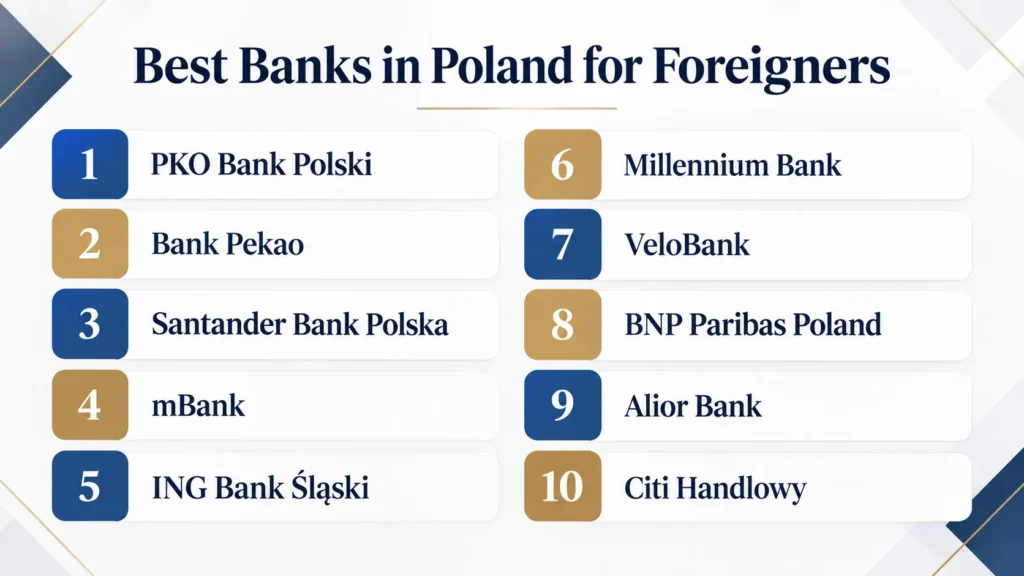
1. PKO Bank Polski
- Largest bank in Poland, with the most extensive branch and ATM network in the country — over 1,200 branches nationwide, making in-person banking convenient almost anywhere.
- Its Konto bez Granic account is built specifically for foreign residents, offering stronger in-branch support for document checks — a strong option for non-EU nationals from India, Ukraine, Belarus, and Georgia.
- The monthly fee is 0 PLN, waived with 5 card transactions a month; no PESEL required for the basic account.
- The IKO app has an English mode, though it isn’t as fully English as mBank or ING.
2. Bank Pekao
- One of Poland’s oldest banks, operating since 1929, with a long-standing reputation among individual and corporate clients.
- Offers multilingual staff at branches in Warsaw, Kraków, and Wrocław — useful if you’d rather sort out account issues in person than through an app.
- Monthly fee is 0 PLN, waived with one inbound transfer a month, and the app is available in English.
3. Santander Bank Polska
- Part of the Spanish banking group Banco Santander, with more than 500 branches and 24/7 account access via online and mobile banking.
- Well suited to non-standard employment situations, including umowa zlecenie contracts and B2B contractors.
- The monthly fee is 0 PLN, waived with a minimum 300 PLN card spend, and the app is fully available in English.
4. mBank
- A fully digital-first bank known for the fastest online account opening among the major Polish banks — EU citizens can open an account with just a passport.
- Offers a full English-language mobile app and English-speaking phone support, making it one of the most foreigner-friendly banks in Poland.
- Monthly fee is 0 PLN, waived with a single card transaction a month; non-EU applicants may need one branch visit.
5. ING Bank Śląski
- A subsidiary of the Dutch ING Group, offering one of the most user-friendly banking apps in Poland alongside a strong sustainability focus.
- Provides full English-language banking and 24/7 account access online.
- Monthly fee is 0 PLN, waived with either 1,000 PLN in monthly income or 5 card payments — no PESEL required.
6. Millennium Bank
- The most accessible option for foreigners who haven’t yet received a PESEL number — account opening requires only a valid passport.
- Offers a fully English mobile app and remote (online) account opening.
- Konto 360° includes free ATM withdrawals in Poland and abroad, a free Visa debit card, and no monthly fee if you make at least one card payment and receive 1,000 PLN monthly.
7. VeloBank
- One of the few Polish banks offering a fully free account with no monthly fee and no conditions attached.
- Includes up to 50 PLN in monthly cashback, making it a strong pick for foreigners who want zero-fee banking without meeting a spend or income threshold.
- Account opening requires only a passport — no PESEL needed — though English-language support is more limited than at mBank or ING.
8. BNP Paribas Poland
- Best suited to foreign-owned companies that need a bank with international corporate banking experience.
- Accepts foreigners with a passport, with monthly fees ranging from 0–15 PLN depending on account tier.
- Specializes in handling the heavier documentation that comes with company accounts, including KRS extracts, board resolutions, and multi-currency business needs.
9. Alior Bank
- Historically one of the more competitive Polish banks on savings account interest rates, though rates move with NBP policy and promotional cycles — verify the current published rate before relying on it.
- Poland applies a 19% Belka tax on interest income, so the actual after-tax return on any savings account is lower than the advertised rate.
- The standard current account has no monthly fee under normal activity conditions, making it a solid secondary account for parking PLN savings alongside a primary everyday bank.
10. Citi Handlowy
- Operating in Poland since 1870 and now part of Citigroup, geared toward corporate and international clients rather than everyday personal banking.
- The strongest option for foreigners who need frequent international wire transfers or already have a Citi relationship abroad.
- Fees vary by account tier, and English-language support is strong given its global corporate focus.
Best Bank in Poland for Your Situation
- No PESEL yet: Millennium Bank or mBank — both let you open before your PESEL arrives.
- Non-EU national: PKO Bank Polski’s Konto bez Granic is built for foreign residents from India, Ukraine, Belarus, Georgia, and similar countries, with stronger in-branch document support.
- Indian, Bangladeshi, or Sri Lankan national: you’ll need the same core documents as other non-EU applicants — passport, residence permit or Karta Pobytu (or a visa if the permit is pending), your PESEL or the gmina-issued zaświadczenie confirming you’ve applied for one, and proof of a Polish address. Bringing an employer reference letter or work contract can speed things up, since some branches ask for extra verification when the only document on file is a long-stay national visa.
- Company owner in Poland: mBank, PKO Bank Polski, or ING Bank Śląski. Foreign-owned companies should have KRS, NIP, REGON, board resolution, and shareholder documents ready.
- Digital nomad or remote worker: mBank or ING as your main Polish account, paired with Wise for foreign-currency payments — not Revolut alone, since it doesn’t support BLIK.
- Student under 26: mBank eKonto Studenckie, designed for young students with fewer account-maintenance requirements.
- Frequent traveler: Santander Bank Polska for international banking access, paired with Revolut for everyday multi-currency spending.
Conclusion
The right Polish bank depends on your situation. Foreign residents who need branch support may prefer traditional banks, while digital-first users may value mobile banking and English support.
Before choosing an account, compare documentation requirements, fees, and whether the bank supports your long-term plans in Poland. Whether you want PKO’s branch network, Pekao’s legacy trust, or mBank and ING’s digital-first experience, Poland’s banking sector has an option built for your situation.
If you’re ready to set up your company and open a business bank account in Poland, our local experts can make the whole process hassle-free. Contact us today for a free consultation, and let’s build your success story in Poland together.
FAQs
Which bank in Poland is best for foreigners?
It depends on your situation. mBank and PKO Bank Polski are the strongest all-round options for most foreigners; Millennium Bank is best if you don’t have a PESEL yet; and PKO’s Konto bez Granic is specifically built for non-EU nationals. See the “Best Bank for Your Situation” section above for the full breakdown.
Can non-residents open a bank account in Poland?
Yes. Non-residents can open a Polish bank account, though they typically need to provide a passport, and non-EU applicants usually also need a residence permit or visa.
Are these banks safe and reliable?
Yes — every bank in this guide is regulated by the Polish Financial Supervision Authority (KNF).
What documents are required to open an account?
In 2026, most major banks including PKO Bank Polski and mBank no longer require a PESEL before opening your account — you can apply for both at once. EU citizens typically need a passport plus proof of a Polish address. Non-EU citizens need a passport, residence permit or visa, and income documentation.
What is BLIK, and do I need it?
BLIK is Poland’s mobile payment system, built into every major bank’s app, letting you pay with a 6-digit code instead of a card and used for an estimated 60%+ of online payments in the country.
It only works with Polish bank accounts — Revolut and Wise don’t support it — which is why most foreigners keep a Polish bank account even if they also use an international app.