The Czech Republic is regarded as one of the most attractive business locations in Central Europe, with strong human resources, excellent tax rates, and a strategic position. While the country is relatively favourable for corporate taxes in the Czech Republic, there are also a number of other tax obligations that companies must meet, including value-added tax (VAT), payroll tax, real estate tax, and withholding taxes. Maintaining compliance with these regulations is crucial for businesses aiming to run smoothly and adhere to local laws.
Changes in legislation and increased tax authority regulation have the potential to affect a company’s total tax burden. It is therefore important for entrepreneurs and investors to understand the Czech tax framework before they start their businesses in the Czech Republic. This article explains the main corporate taxes that apply in the Czech Republic, as well as the tax incentives and related filing procedures for companies.
What are the 7 Types of Corporate Taxes in the Czech Republic?
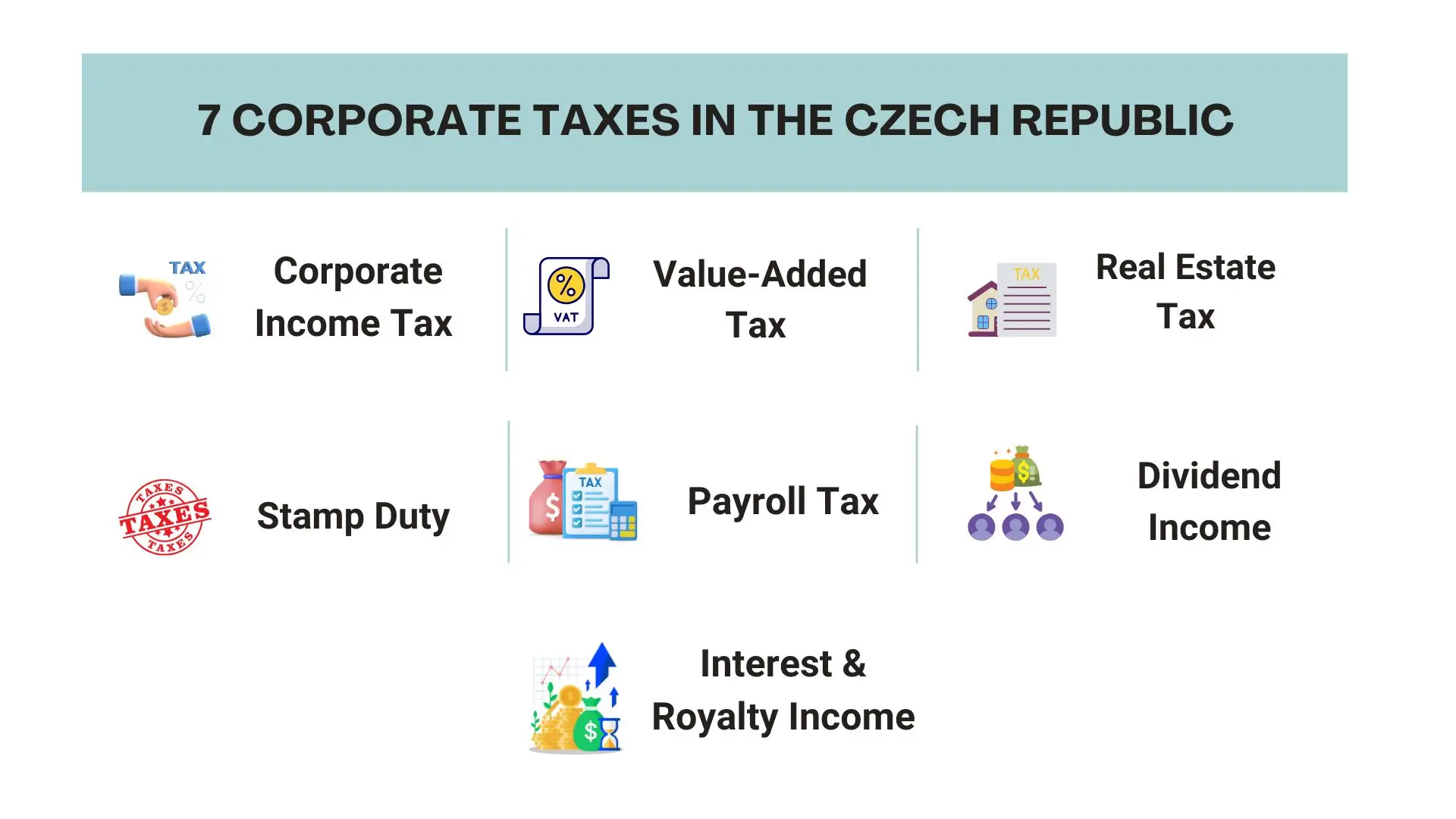
If you incorporate a business in the Czech Republic, you have to pay various business taxes. A corporation must pay the following corporate taxes in the Czech Republic in order to conduct business operations there:
1. Corporate Income Tax (CIT)
Organizations with headquarters in the Czech Republic must pay corporate income tax (CIT) on earnings from global sources. Organizations that are not citizens of the country must pay corporate taxes in the Czech Republic on money generated there.
All company profits, particularly capital gains from the transfer of stocks, are subject to the Czech corporate tax rate of 21%. Dividends received by tax-resident companies in the Czech Republic from non-resident companies are subject to a special CIT rate of 15%.
Pension schemes are exempt from CIT, and certain investment income is subject to a 5% CIT rate.
2. Value-Added Tax (VAT)
The Czech Republic imposes a value-added tax on the supply of products and services. VAT is typically imposed at a rate of 21%. Certain suppliers are subject to a 15% tax rate, and some commodities are subject to a further lowered rate of 10%.
VAT is typically waived for exports with a credit. Certain goods and services are exempted without credit, such as real estate leasing, banking, and insurance activities, as well as goods and services related to education, healthcare, and charity.
3. Real Estate Tax
The proprietor of real estate is obligated to contribute real estate tax every year. The size, region, and intended use of the property or structures all affect the tax’s value. Paved spaces used for commercial reasons are subject to taxation; as such, taxpayers must self-assess the tax.
4. Stamp Duty
The Czech Republic doesn’t have any stamp duties. A notarial fee is charged for certain organizational processes where a notary is required to participate by operation of law.
5. Payroll Tax
In the Czech Republic, employers are required to provide monthly withholdings and yearly reconciling for their workers. Personal income tax, as well as mandated social security and medical insurance, are included in the withholdings.
6. Dividend Income
If not exempted under the participation exemption system:
- Dividends earned by Czech tax resident firms from non-resident organizations are subject to a special rate of 15%.
- Dividends paid to Czech residents are subject to a 15% withholding tax.
- Dividends paid by Czech tax-resident enterprises to non-resident entities are subject to a 15% withholding tax.
7. Interest & Royalty Income
Royalties and interest payments made to tax residents are liable to the 19% corporate tax rate. Interest and royalties acquired by non-residents from a Czech source are subject to a 15% withholding tax unless exemptions or double tax treaties apply.
If the recipient resides in a non-EU/EEA nation or one without a tax treaty, a 35% withholding tax applies.
What Are the Tax Base, Period, and Filing Requirements in the Czech Republic?
- Tax Base and Tax Rates in the Czech Republic: The tax base of a company is generally defined in the Czech Republic as the difference between the taxable income and deductible expenditures of a company, with regard to the items prescribed by the Czech tax regulations. The corporate income tax (CIT) rate is 21%. Some entities can, however, obtain special tax rates, such as 5% CIT for qualifying investment funds or 0% CIT for pension funds and pension insurance institutions.
- Tax Period in the Czech Republic: The tax period is typically the calendar year from 1 January to 31 December. Alternatively, a business can choose a financial year of 12 consecutive calendar months if it meets the requirements of the relevant legislation.
- Deadline for Submitting Tax Returns in the Czech Republic: The deadline for submitting corporate income tax returns is three months after the end of the taxable period. The standard filing dates are usually 1 April of the following year for companies that have the calendar year as their tax period. In some cases, extended filing deadlines may apply, including when returns are filed electronically or by an authorized tax adviser.
What Tax Credits and Incentives Are Available in the Czech Republic?
1. Research & Development (R&D): R&D expenses may qualify for a tax credit, allowing businesses to deduct up to 100% of qualifying R&D costs from their tax base. Additional deductions may apply if current-year expenses exceed those of the prior year.
2. Investment Incentives: Investment incentives are available for companies in the manufacturing sector and technology hubs. Incentives include CIT exemptions, financial aid for job creation and training, capital investment grants, and discounted property transfers.
Who Pays Business Taxes in the Czech Republic?
- Tax Residents: Companies with a registered office or main place of business in the Czech Republic must pay corporate taxes on global profits.
- Permanent Establishments of International Corporations: Foreign companies with a permanent establishment in the Czech Republic pay taxes on income sourced from the country.
Conclusion
The Czech Republic has a competitive and business-friendly tax system, which makes it an attractive place for businesses to expand in the European market. But companies in the country have to deal with various taxes, including corporate income tax, value-added tax (VAT), payroll taxes, real estate taxes, and withholding taxes and be on top of changing tax rules. By understanding Czech taxation, companies can ensure compliance with the tax laws, optimize their tax obligations, and leverage tax incentives like R&D deductions and investment promotion schemes.
Entrepreneurs who wish to start or expand their operations in the Czech Republic can find expert advice to help them navigate the intricacies of local tax laws. Contact OnDemand International for personalized support on company formation, tax structuring, and business compliance in the Czech Republic.
FAQ’s
Do international businesses in the Czech Republic have to pay taxes?
Yes, international businesses have to pay taxes in the Czech Republic on the revenue generated there.
What are the various tax credits and incentives in the Czech Republic?
1. Research & Development- As a special tax credit, the tax base may be used to offset up to 100% of certain Research & Development expenditures generated in a particular tax year. Direct expenses, tax deductions for fixed assets used in research and development, as well as other operating costs, are eligible for the R&D tax credit.
2. Investment incentives- Only organizations based in the Czech Republic, as well as Czech subsidiaries of international corporations, are eligible for investment incentives.
Who is liable for paying corporate taxes in the Czech Republic?
1. Tax Residents- The tax residents must pay corporate taxes in the Czech Republic on all of their global profits.
2. Permanent Establishments of International Corporations- Foreign corporations’ branches and permanent establishments are typically only subject to Czech-source income taxes.
What is the rate of value-added tax in the Czech Republic?
VAT is typically imposed at a rate of 21%. Certain suppliers are subject to a 15% tax rate, and some commodities are subject to a further lowered rate of 10%.