
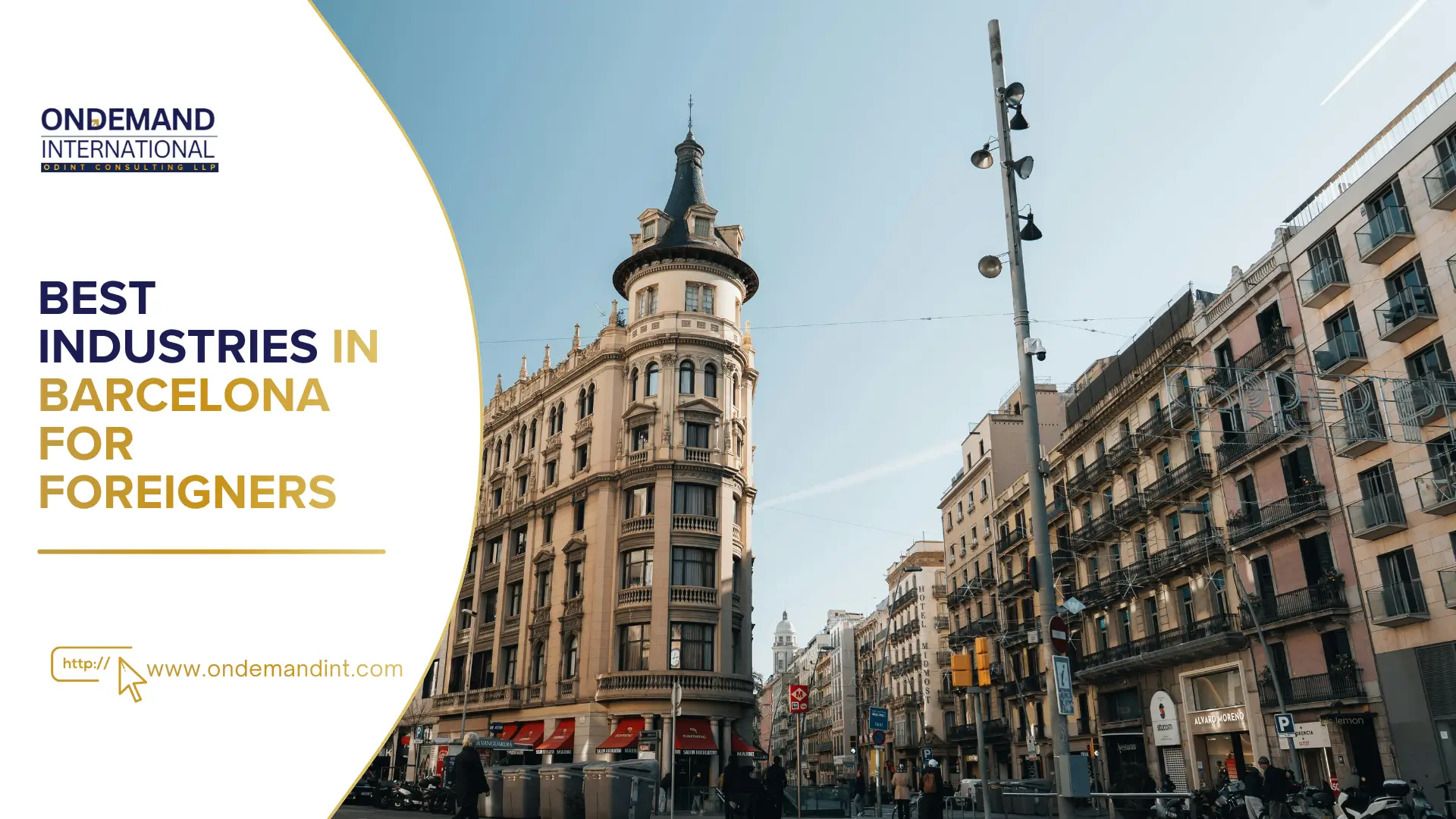
Barcelona is one of Europe’s most competitive cities for foreign-owned businesses — and the data backs it up. The city hosts over 6,000 foreign-registered companies, ranks in Europe’s top five for foreign direct investment, and is home to more than 1,500 active startups. For a non-EU entrepreneur looking to enter the European market, Barcelona offers something most cities cannot: sector depth across multiple industries, not just technology.
But which industries actually make sense for a foreign founder to enter — and why Barcelona specifically, rather than Madrid or Amsterdam?
This guide breaks down the 7 best industries in Barcelona for foreigners, with a focus on market opportunity, ease of entry, and what you need to get started.
7 Best Industries in Barcelona for Foreigners
Listed below are some of the best industries in Barcelona for foreign entrepreneurs:
1. Technology & SaaS
Barcelona is Spain’s undisputed technology capital, attracting over €1.5 billion in tech investment annually. The city’s talent pool — fed by institutions like Universitat Politècnica de Catalunya (UPC) and ESADE — is multilingual, technically skilled, and significantly more affordable than equivalent talent in London or Paris.
For foreign founders, the tech sector offers the most established support infrastructure: accelerators like Wayra and South Summit, coworking spaces, and a dense network of angel investors and VC funds with experience backing non-EU teams.
Entry angle for foreigners: SaaS products targeting European SMEs, AI tooling, cybersecurity, and edtech are the highest-growth sub-sectors. Barcelona’s timezone also makes it an ideal base for companies serving both European and Latin American markets simultaneously.
2. Logistics & Trade
Barcelona’s port is the busiest in the Mediterranean and one of the top ten in Europe by container volume. For foreign entrepreneurs in import-export, distribution, or supply chain management, this is a structural advantage that no other Spanish city can match.
The city’s free trade zone — the Zona Franca — is one of the oldest and largest in Europe, offering customs benefits, warehousing, and simplified administrative procedures for companies operating across borders.
Entry angle for foreigners: Cross-border e-commerce fulfillment, cold chain logistics for food exports, and third-party logistics (3PL) services are particularly underserved segments with strong demand from both EU and non-EU trading partners.
3. Tourism & Hospitality Experiences
Barcelona receives over 12 million tourists annually, making it one of Europe’s most visited cities. But the opportunity for foreign entrepreneurs is not in mass tourism — that market is saturated. The real gap is in premium, niche, and experience-led hospitality.
Foreign founders bring a natural advantage here: an outsider’s perspective on what international visitors actually want, versus what locally-run operations assume they want.
Entry angle for foreigners: Boutique accommodation, culturally-curated food tours, luxury day trips to the Costa Brava, and wellness retreats targeting the growing market of experience-focused travellers. Barcelona’s year-round Mediterranean climate reduces the seasonal risk that affects most European tourism businesses.
4. Life Sciences & Biotechnology
Barcelona is Spain’s leading life sciences cluster, home to institutions like the Barcelona Supercomputing Centre and the Barcelona Institute of Science and Technology. The sector employs over 30,000 people in the greater Barcelona area and has seen consistent double-digit investment growth over the past five years.
For foreign entrepreneurs with backgrounds in healthcare, pharmaceuticals, or medical devices, Barcelona’s ecosystem offers access to both EU regulatory frameworks and a strong base of academic research partners.
Entry angle for foreigners: Medical device commercialisation, health data analytics, clinical research services, and nutraceuticals targeting the European wellness market. Spain’s pharmaceutical sector is the fourth largest in the EU by production volume.
5. Creative Industries & Digital Content
Barcelona has a well-established creative economy spanning design, architecture, gaming, film production, and digital marketing. The city hosts the Mobile World Congress — the world’s largest mobile industry event — which has cemented its reputation as a hub for digital innovation beyond just software.
Foreign entrepreneurs in content creation, creative agencies, and media production find Barcelona particularly accessible: the cost of operating a creative studio is 30–40% lower than in equivalent Western European cities, while the talent quality is comparable.
Entry angle for foreigners: UX/UI design studios, multilingual content agencies targeting the EU market, mobile gaming studios, and video production companies serving international brands with a European presence.
6. Sustainable Energy & CleanTech
Catalonia is Spain’s most industrialised region, and Barcelona is increasingly positioning itself as a hub for sustainable technology and green business. The EU’s Green Deal has directed significant funding toward CleanTech innovation in Spain, and Barcelona’s local government has set ambitious net-zero targets that are creating commercial demand for clean energy solutions.
Entry angle for foreigners: Solar energy services for commercial properties, energy efficiency consulting for the real estate sector, EV charging infrastructure, and waste-to-energy solutions. Non-EU entrepreneurs with backgrounds in energy can access EU CleanTech funding streams once incorporated in Spain.
7. Education & Professional Training
Barcelona’s large international community — over 250,000 foreign residents — creates consistent demand for language schools, professional certification programmes, and international school alternatives. The city is also home to several globally ranked business schools, creating a strong premium education market.
Entry angle for foreigners: English-language professional training, international curriculum tutoring, online-to-offline hybrid learning programmes, and corporate language training for multinationals based in the city.
How to Enter Barcelona as a Foreign Entrepreneur?
To operate any business in Barcelona, foreign founders need to register a legal entity in Spain. The most common structure is the Sociedad Limitada (SL) — Spain’s equivalent of a private limited company — which allows 100% foreign ownership and can be incorporated in 2–3 weeks.
Under Spain’s Ley de Startups (2023), qualifying foreign founders can also access a dedicated entrepreneur visa, a reduced corporate tax rate of 15% for the first four years, and simplified incorporation procedures — making Barcelona one of the most accessible EU cities for non-EU nationals to establish a business base.
At OnDemand International, we handle company registration in Barcelona alongside immigration and mobility support from our office in the city. If you’re evaluating which industry fits your profile and how to structure your entry, speak with our Spanish team or explore our global mobility services in Spain.
Conclusion
Barcelona offers strong opportunities for foreign entrepreneurs looking to enter the European market in 2026. With growing sectors such as technology, logistics, tourism, life sciences, creative industries, CleanTech, and education, the city provides multiple business entry points for non-EU founders.
However, success depends on more than choosing the right industry. Foreign entrepreneurs must also select the correct company structure, meet Spanish compliance requirements, and plan their immigration or residency pathway carefully.
With proper guidance, Barcelona can become a powerful base for business growth, EU market access, and long-term international expansion. OnDemand International can help you identify the right sector, register your Spanish company, and structure your business setup in Spain from start to finish.
FAQs
Which industry is best in Barcelona for a foreign entrepreneur with no local contacts?
Technology and logistics offer the most established foreign-founder communities, with strong accelerator networks and English-language professional ecosystems that reduce the barrier of not having local connections.
Can a non-EU national own 100% of a company in Barcelona
Yes. Spain permits 100% foreign ownership of a Sociedad Limitada (SL) with no local partner requirement.
Which Barcelona industries attract the most foreign direct investment?
Technology, life sciences, logistics, and creative industries lead FDI inflows into Barcelona, according to fDi Intelligence data.
Is Barcelona better than Madrid for foreign business setup?
It depends on the sector. Barcelona leads in tech, life sciences, logistics, and creative industries. Madrid has an advantage in financial services and government-facing sectors.
How long does it take to register a company in Barcelona as a foreigner?
Typically 2–3 weeks for an SL with full documentation. OnDemand International manages the process end-to-end.