
The cross-border operation creates opportunities in new markets, diverse talent, and faster growth. However, it also presents businesses with one of the most complicated issues in international trade: international compliance risk for foreign companies. From the changed tax liability to the changing data privacy provisions and anti-corruption compliance regulations, the regulatory environment of 2026 requires foreign firms to view compliance not as a checkbox task but as a business operation strategy.
This guide divides all the key dimensions of international compliance risk, its meaning to your business, and how to handle it effectively before it turns into an expensive liability.
What Is International Compliance Risk?
International compliance risk is defined as the legal, financial, and reputational damage a business faces when it cannot meet the regulatory requirements of a foreign country where it operates. In contrast to domestic compliance, where a company operates within a single legal framework, international business compliance requires companies to simultaneously satisfy multiple and sometimes conflicting sets of rules in different jurisdictions.
As organizations prepare for 2026, compliance leaders must operate in an increasingly complex enforcement environment shaped by national security concerns, regulatory frameworks, and technological shifts, with authorities around the globe intensifying their enforcement of trade compliance, fraud prevention, and artificial intelligence integration.
This is not a theoretical risk to foreign companies. Late filing, an ignored data protection requirement, or a payment made without the right documents can lead to a large fine, operations suspension, or even a damaged reputation in a market that you have spent years building.
Why Is Compliance Risk Higher for Foreign Companies?
The compliance burden is structurally higher for foreign companies compared to domestic businesses for a number of reasons. First, they operate without the institutional familiarity that local businesses naturally develop over time. Second, they can face the laws of their home country and those of the host country at the same time, simultaneously forming a dual compliance responsibility, and the risk of oversight is multiplied.
International regulation is moving towards local, country-led agendas, leading to various approaches and greater unpredictability, a trend that will increasingly become a challenge to international companies.
Third, enforcement against foreign companies is intensifying. Regulators in the United States, European Union, United Kingdom, and the Asia-Pacific region are actively developing cross-border investigations, and now it is much more difficult to use jurisdictional borders as a shield against enforcement action by foreign businesses.
Types of International Compliance Risks
The key to any effective global regulatory compliance strategy is to understand the particular types of international compliance risks, such as
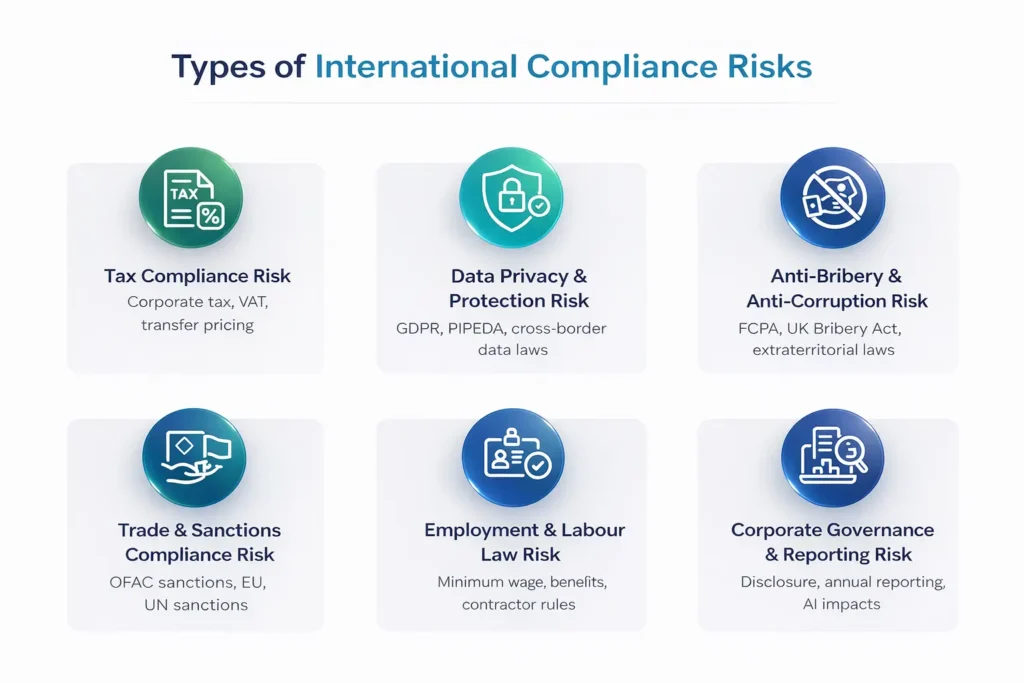
1. Tax Compliance Risk
- The most confusing part of the foreign company regulations is the tax requirements.
- Foreign firms have to negotiate corporate income tax, withholding tax, transfer pricing regulations, value-added tax (VAT) or goods and services tax (GST), and permanent establishment requirements, all of which differ widely in different countries.
- Missteps in establishing a permanent establishment in a jurisdiction, such as one, will lead to years of back taxes, interest, and penalties.
2. Data Privacy & Protection Risk
- One of the most actively enforced fields of international business compliance has been data privacy.
- The General Data Protection Regulation of the European Union (GDPR) is very strict on any company collecting or processing data of EU residents, no matter where the organization is located.
- Canada has PIPEDA, and the United States has a collection of federal and state-level data laws, including the California Consumer Privacy Act (CCPA).
- New regulations limit, and in certain cases prohibit, some types of cross-border data transactions of bulk sensitive personal data, and unlike some regulations, these rules do not have a consent exemption or a personal opt-out provision, so compliance at the structural level is necessary.
3. Anti-Bribery & Anti-Corruption Risk
- Anti-corruption laws with extraterritorial effect will be obligatory for foreign companies that conduct business in high-risk markets.
- The United States Foreign Corrupt Practices Act (FCPA), the UK Bribery Act, and related laws in Canada and Australia can open a foreign company to prosecution in its own country for an entirely foreign act.
- The anti-corruption situation in the Asia-Pacific is rapidly changing, with regulators deploying bold new tactics, record fines, and unprecedented penalties—cross-border collaboration is intensifying, and executives now face real risks of personal accountability.
4. Trade & Sanctions Compliance Risk
- Global compliance challenges are being faced by businesses against a backdrop of global conflict, geopolitical rebalancing, reversals in domestic policy, and increasingly complex international commercial relationships.
- Foreign companies must screen their transactions. suppliers, and partners against sanctions lists maintained by the United States Office of Foreign Assets Control (OFAC), the EU, and the United Nations to avoid unknowing violations that carry severe financial penalties.
5. Employment & Labour Law Risk
- Hiring employees in a foreign country creates immediate compliance obligations under local employment law — including minimum wage requirements, mandatory benefits, termination procedures, and social security contributions.
- Many countries also have strict rules governing the use of independent contractors versus employees, and misclassification can trigger significant back-payment obligations.
6. Corporate Governance & Reporting Risk
- Foreign companies listed on international exchanges or operating subsidiaries abroad must meet local corporate governance standards, annual reporting requirements, and disclosure obligations.
- Risk factor disclosure is a critical part of annual reporting obligations, and companies must consider developments, including AI impacts, economic uncertainty, and international geopolitical developments, such as tariff imposition, when updating their disclosures.
Country-Specific Compliance Risks Foreign Companies Must Know
Although compliance risk is universal, it takes very different forms depending on the market. Here is a snapshot of key risks by region:
- United States: The FCPA, False Claims Act, OFAC sanctions, and state-level data privacy laws create a multi-layered compliance environment. Non-US companies that have access to US federal contracts need to keep track of their contract terms, review their internal practices, and be ready to face scrutiny in the changing enforcement priorities.
- European Union: GDPR is the most comprehensive data privacy framework in the world. A new wave of EU compliance regulations takes effect in 2026, including the Carbon Border Adjustment Mechanism, the Energy Performance of Buildings Directive, and the EU’s Green Claims and Consumer Empowerment Rules.
- United Kingdom: The UK starts 2026 in a more dynamic corporate enforcement landscape, with the Serious Fraud Office conducting more rapid investigations and a new Failure to Prevent Fraud offence increasing corporate expectations on corporate controls.
- Asia-Pacific: Regulatory expectations are becoming increasingly rapid in China, Singapore, Japan, and Australia. Multinational enterprises should closely monitor geopolitical developments, strengthen supply chain due diligence, and adopt proactive risk mitigation strategies such as dual-track sourcing and contractual clauses addressing political force majeure.
Consequences of Non-Compliance for Foreign Companies
The consequences of not handling international compliance risk go way beyond financial fines. They include:
- Financial penalties—Regulatory fines may exceed hundreds of millions of dollars. Violation of GDPR in itself results in penalties of up to 4% of the yearly turnover.
- Criminal liability—Directors and senior officers may be subjected to personal criminal prosecution both in the host country and in their own jurisdiction.
- Operational disruption—Regulators can suspend licenses, freeze assets, or prohibit a company from operating in their jurisdiction entirely.
- Reputational damage—A publicized compliance failure can irreparably damage relationships with customers, partners, and investors in a market.
- Supply chain impact — Sanctions violations or trade compliance failures can disrupt entire supply chains, triggering contractual penalties with downstream partners.
How to Manage International Compliance Risk Effectively?
Effective compliance risk management for foreign companies requires a proactive, structured approach rather than a reactive one. The following framework represents the existing best practices in the global areas of regulatory compliance:
Conduct a Comprehensive Risk Assessment
Foreign companies must undertake jurisdiction-specific risk analysis in the areas of tax, employment, data privacy, anti-corruption, and trade compliance requirements before entering any new market. A properly designed compliance role based on the risk profile of the company, decision-making processes, and a clear understanding of the business operations contributes to sustainable expansion and timely detection of problems.
Appoint Local Compliance Counsel
Engaging a qualified local law firm in every operating jurisdiction is not a choice, but rather a necessity. Local counsel also introduces jurisdiction-related knowledge that a global framework cannot fully duplicate, especially in markets with fast-changing regulations for foreign companies.
For businesses operating across multiple jurisdictions, understanding where can I get assistance with international business compliance? can help simplify ongoing regulatory obligations.
Implement a Centralised Compliance Management System
Foreign companies operating across multiple jurisdictions need a centralized system to track regulatory deadlines, maintain compliance documentation, and flag emerging risks. Technology tools including compliance management platforms and AI-powered regulatory monitoring systems are increasingly standard among multinational businesses.
Train Employees Across All Jurisdictions
Compliance failures are frequently caused by employee conduct rather than intentional wrongdoing. Regular training on anti-corruption policies, data handling procedures, and reporting obligations ensures that every member of your team understands their personal compliance responsibilities.
Build a Culture of Voluntary Disclosure
Regulators in multiple jurisdictions, including the US Department of Justice and the UK Serious Fraud Office, offer significantly reduced penalties to companies that self-report compliance violations promptly and cooperate fully with investigations. Building internal channels that encourage early reporting is one of the most cost-effective compliance risk management investments a foreign company can make.
Common Mistakes Foreign Companies Make in International Compliance
Even well-resourced companies make avoidable compliance errors when expanding internationally. The most common include the following:
- Assuming home-country compliance standards are sufficient abroad
- Underestimating the extraterritorial reach of laws like GDPR and the FCPA
- Delaying local legal registration while already conducting business activities
- Failing to update compliance programmes when entering new markets or launching new products
- Treating compliance as a legal function rather than a business-wide responsibility
Conclusion
International compliance risk for foreign companies is one of the defining business challenges of 2026. Building agility into compliance strategy is critical; the companies best positioned to thrive will be those that embed compliance intelligence into cross-functional decision-making, connecting policy tracking to procurement, operations, and investment strategy.
Whether you are entering Canada, the United States, the European Union, or any market in the Asia-Pacific, understanding and managing your international compliance risk is not simply a legal obligation; it is a competitive advantage.
OnDemand International specializes in helping foreign companies navigate international compliance risk, from company formation to ongoing regulatory support. Get in touch with our experts today.
FAQ’s
What is international compliance risk for foreign companies?
International compliance risk refers to the legal, financial, and reputational harm a foreign company faces when it fails to meet the regulatory requirements of the country it operates in. It covers tax, data privacy, anti-corruption, employment law, and trade compliance obligations.
Why do foreign companies face higher compliance risks than domestic businesses?
Foreign companies must simultaneously satisfy both their home country’s laws and the host country’s regulations, creating a dual compliance burden. They also lack the institutional familiarity that local businesses naturally develop over time.
What is GDPR, and does it apply to foreign companies?
GDPR is the European Union’s General Data Protection Regulation, which governs how personal data of EU residents is collected, stored, and processed. It applies to any company worldwide that handles EU resident data — regardless of where the company is based.