
Australia has quietly become one of the most attractive destinations for Indian entrepreneurs in 2026. A AAA-rated economy, 100% foreign ownership, a thriving Indian diaspora of over 800,000 people, and one of the fastest company registration processes in the world — it checks every box a global founder is looking for.
The Australia-India ECTA (Economic Cooperation and Trade Agreement) has further reduced trade barriers, making it easier than ever to move goods, services, and capital between the two countries. If you have been waiting for the right moment to expand your business in Australia from India, this is it.
Listed below, we have covered the top 7 best business opportuntity for Indian entrepreneurs in Australia.
Top 7 Best Business Opportunities for Indian Entrepreneurs in Australia
Here are the 7 best business opportunities for Indian entrepreneurs in Australia right now.
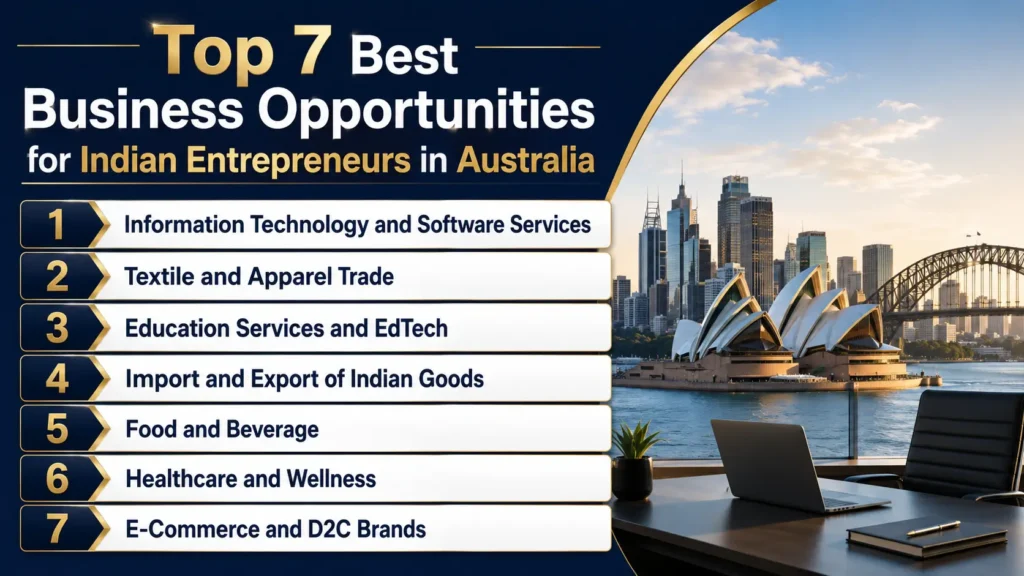
1. Information Technology and Software Services
Australia has a massive and growing demand for software development, cloud infrastructure, cybersecurity, and AI integration — and a chronic shortage of local tech talent to meet it. Indian IT entrepreneurs are structurally positioned to fill this gap better than almost anyone else.
The model that works best: set up an Australian Pty Ltd as the commercial face of the business, place a small client-facing team in Australia, and run delivery from India.
This gives enterprise clients the local entity and ABN they require, while keeping your cost base competitive. High-demand niches in 2026 include AI workflow automation, cybersecurity for mid-market businesses, and digital transformation for the resources sector.
2. Textile and Apparel Trade
This is one of the most underrated opportunities in the India-Australia corridor — and one that Indian entrepreneurs are uniquely positioned to exploit.
India is the world’s second-largest textile producer. Whether it is Jaipur block prints, Varanasi handlooms, Chanderi silk, or Tiruppur performance fabric, Indian textiles offer quality and variety that Australia’s import market cannot easily source elsewhere.
Under ECTA, tariffs on cotton yarn, woven fabrics, and readymade garments have been significantly reduced — a structural advantage for entrepreneurs looking to start a textile business from India.
Business models with strong returns: wholesale import and distribution to Australian retailers and boutiques; private label apparel manufactured in India and sold under an Australian brand; home textiles (bedlinen, cushion covers, throws) supplied to homeware chains; and B2B fabric supply to Australian garment manufacturers and uniform companies.
Australian consumers are also increasingly drawn to sustainable, artisan-produced fashion — a narrative Indian handloom producers can tell with authenticity.
3. Education Services and EdTech
India is now the single largest source of international students to Australia. Over 600,000 international students are enrolled in Australian institutions, and a significant and growing share come from India. This creates a layered ecosystem of business opportunities for Indian founders.
Student recruitment agencies earn placement commissions from Australian universities and VET providers. The market is competitive, but differentiation through regional specialisation or postgraduate pathways is achievable.
The bigger long-term opportunity is EdTech: Australian schools and universities are actively seeking STEM and coding learning tools, and Indian EdTech companies with proven products can localise and enter this market faster than building from scratch.
Tutoring businesses in mathematics, science, and competitive exam preparation also have strong demand in Melbourne and Sydney.
4. Import and Export of Indian Goods
Beyond textiles, India’s export basket has real commercial depth for the Australian market. Packaged Indian foods — masalas, chutneys, snacks, lentils — are no longer confined to ethnic grocery stores; mainstream Australian supermarkets are actively stocking them.
Ayurvedic and herbal wellness products have a clear pathway through Australia’s TGA complementary medicines register.
Artisan handicrafts, brassware, and hand-carved home decor find steady demand through interior designers and homeware retailers. Engineering components and auto parts are increasingly sourced by Australian manufacturers from India.
The import-export model suits founders with existing sourcing networks in India who want a formal Australian commercial entity to sell into the market professionally and at scale.
Read More: How to Start a Bookkeeping Business in Australia from India?
5. Food and Beverage
Indian food is mainstream in Australian cities. The opportunity in 2026 is not to open another traditional Indian restaurant — it is to build a format-led food business.
Focused quick-service concepts built around a single regional cuisine (South Indian, Punjabi dhaba, Hyderabadi biryani) have shown stronger unit economics than full-service restaurants with sprawling menus.
Cloud kitchens in Sydney and Melbourne allow Indian founders to test the market with low fixed costs before committing to a lease. Food manufacturing — producing Indian ready meals, sauces, or spice blends at scale for supermarkets, airlines, or food service distributors — is a B2B model with significantly higher growth potential than a single outlet.
Indian mithai and festive sweets also drive year-round revenue, not just during festival seasons.
Also Read: How to Start a Spices Business in Australia From India?
6. Healthcare and Wellness
Indian entrepreneurs with healthcare management backgrounds are setting up NDIS-registered providers and aged care services staffed by Indian-origin nurses, physiotherapists, and allied health professionals arriving on skilled visas.
On the wellness side, demand for yoga studios, Ayurvedic clinics, and holistic health services is growing beyond the Indian community. Australian consumers aged 35–55 are the core market, and Indian-owned wellness businesses in inner-city suburbs of Melbourne and Sydney are seeing strong non-Indian clientele. AHPRA registration requirements apply to practitioners — regulatory advice before setup is essential.
7. E-Commerce and D2C Brands
The Australian e-commerce market exceeded AUD 63 billion in 2025 and remains less saturated than comparable Western markets at the mid-market and niche level. For Indian founders, the structural opportunity is to manufacture in India and sell in Australia — capturing the cost advantage on the supply side while pricing in AUD on the demand side.
Channels include Amazon.com.au, eBay Australia, and direct Shopify stores. Indian-origin D2C brands in sustainable cotton apparel, natural skincare, yoga accessories, and specialty food are gaining traction with mainstream Australian consumers, not just the diaspora.
Inventory can be held at a 3PL warehouse in Australia for faster fulfilment, or shipped per order for lower upfront commitment.
Conclusion
Australia is not a distant opportunity — for Indian entrepreneurs in 2026, it is an immediate one. With 100% foreign ownership, a fast incorporation process, ECTA trade benefits, and a large, established Indian community across Sydney, Melbourne, and Brisbane, the barriers to entry have never been lower.
Whether you are an IT founder looking for enterprise clients, a textile exporter ready to tap a new market, or a food entrepreneur with a concept worth scaling, Australia offers the infrastructure, the demand, and the regulatory clarity to make it work. The only question is which sector fits your strengths. OnDemand International is here to help you answer that — and act on it.
FAQs
Can an Indian citizen own 100% of an Australian company?
Yes. Australia allows full foreign ownership with no requirement for a local partner.
What does it cost to set up an Australian company?
Practical setup costs range from AUD 2,000 to AUD 5,000 for ASIC registration, legal fees, ABN, and GST registration.
Do I need to be in Australia to register a company there?
No. With a nominee director in place, you can incorporate and operate an Australian Pty Ltd from India.
Is there a double taxation treaty between India and Australia?
Yes. The India-Australia DTAA covers dividends, royalties, interest, and business profits, making cross-border operations tax-efficient.