A Dutch BV, short for besloten vennootschap, is a private limited company. It is a legal entity in its own right, so the company has its own rights and obligations, separate from its owners. One person or partners can start it, and its capital is divided into shares held by shareholders. That separation between owner and company underlies most of the reasons to set up a BV in the Netherlands.
International entrepreneurs usually choose a Dutch BV for practical reasons. It limits personal financial risk, needs no minimum starting capital, and can be adjusted to suit one owner or several investors. The Netherlands also offers a two-step corporate tax rate and incentives for research and development, and as an EU member state, it gives access to the single market. The sections below cover seven of these benefits and mark the ones that depend on eligibility.
What Are the Reasons to Set Up a BV in the Netherlands?
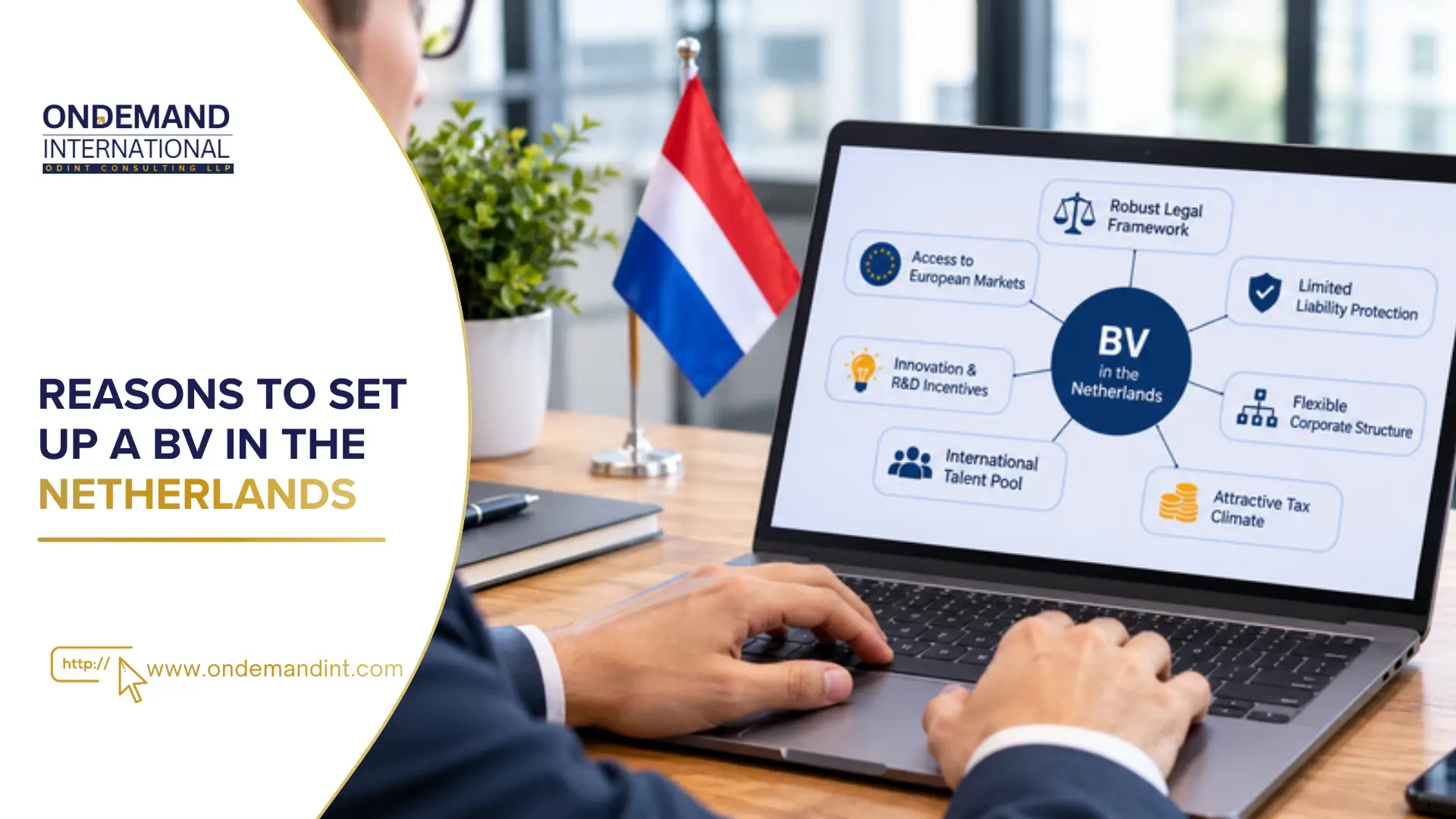
A Dutch BV offers several advantages for entrepreneurs looking to establish or expand a business in the Netherlands. From limited liability and flexible ownership to tax benefits and access to the European market, these advantages can make it a suitable structure for both local and international businesses. Here are seven key reasons to consider setting up a BV in the Netherlands.
1. Robust Legal Framework and Business Environment
A Dutch BV is a recognised legal form with defined rules for owners, directors, and record-keeping. As a legal entity, the business itself has rights and obligations under the law. BVs also keep accounts and deposit financial statements with the Netherlands Chamber of Commerce (KVK), with the required detail depending on company size.
Ownership is also formally recorded. Registered BV shares can only be transferred through a civil-law notary. For banks, partners, and investors, that makes it easier to see who owns and runs the company.
2. Limited Liability Protection
A Dutch BV generally keeps its owners’ personal assets out of reach of business creditors. In most cases, creditors of a BV have no claim on the owner’s personal assets. Owners become personally liable for business debts only in exceptional cases. Examples include serious mismanagement or a personal guarantee given to a lender.
For an entrepreneur starting in a new market, this means a failed contract or unpaid supplier invoice stays a company problem. It also makes bringing in co-owners or investors simpler, since each person’s exposure is tied to their stake in the company.
3. Flexible Corporate Structure
A BV can be as simple as one owner running one company, or it can have several shareholders and a layered governance setup. You do not need starting capital. The minimum share capital is just €0.01.
Governance can grow with the business. A BV may appoint a supervisory board to oversee its directors or place the supervisors on the board of directors itself. Founders plan to raise funds and can issue shares to investors without changing the legal form. Founders can then set out details such as voting rights and profit sharing in the articles of association and any shareholder agreement.
4. Attractive Tax Climate
A Dutch BV pays corporate income tax at 19% on taxable profit up to €200,000 and 25.8% on the excess. The Dutch government describes the bracket above €200,000 as €38,000 plus 25.8% of the excess. For example, a BV with €300,000 in taxable profit would pay €38,000 on the first €200,000 and €25,800 on the remaining €100,000, for a total of €63,800. The 2027 Tax Plan proposes no change to these rates.
Another of the Dutch BV tax advantages is the participation exemption. In general, a BV that holds at least 5% of another company can receive dividends and capital gains from it without paying Dutch corporate income tax, provided it meets the conditions. The Belastingdienst treats dividends from a 5% or greater holding as participation dividends. The exemption has several tests, so a tax adviser should confirm it applies to your structure. Shareholders may also owe tax on dividends they receive, depending on where they live.
5. Access to European Markets
A BV registered in the Netherlands is an EU-based company, so it can trade within the EU single market. The single market allows goods, services, capital and people to move between member states under shared rules. The European Commission explains this on its single market pages. Local requirements such as VAT registration, product standards and sector licences still apply in each country where you sell, so market access does not remove compliance duties.
6. Innovation and Research & Development Incentives
Two Dutch schemes can lower the cost of innovation for a BV. Both depend on meeting specific conditions.
The first is WBSO, a reduction in the payroll tax a company pays on wages for qualifying R&D work. It is not a cash grant. For 2026, the reduction is 36% of the first €391,020 of R&D costs and 16% of the costs above that, with a 50% rate on the first bracket for start-ups. You apply through the Netherlands Enterprise Agency (RVO), and you must apply before the R&D work begins, as retrospective applications are not accepted.
The second is the Innovation Box. A company can choose a special rate for profits from intangible assets it developed itself, which gives an effective rate of 9%. The Belastingdienst sets the qualifying conditions, so check them against your own R&D activities.
7. International Talent Pool
A BV can employ people recruited from abroad, and a tax facility can reduce the cost. Under the expat ruling, formerly known as the Dutch 30% ruling, an employer can pay part of an eligible employee’s salary tax-free. From 1 January 2027, the tax-free share falls from 30% to 27%, and the salary requirement rises. Eligibility depends on the individual employee and requires approval from the Belastingdienst, so confirm the current thresholds on the RVO or Belastingdienst pages before planning around it.
Conclusion
The main reasons to set up a BV in the Netherlands come down to a few clear points. It limits owners’ personal liability, needs no minimum starting capital, and can be adapted to different ownership and governance setups. It also offers a two-step corporate tax rate, access to the EU single market, and incentives such as WBSO and the Innovation Box for qualifying businesses.
For international entrepreneurs, these benefits make the Netherlands a practical base for building or expanding a European business. Some advantages apply to every BV, while others depend on your activities, your team, and your tax position. That is why it helps to check how each one applies to your own plans before you commit. If you are considering setting up a BV in the Netherlands, OnDemand International can help you work out whether a Dutch BV suits your plans and talk through the next steps. Contact our team for professional guidance and support.
FAQs
What are the main reasons to set up a BV in the Netherlands?
The main reasons are limited liability for owners, a flexible structure with no minimum starting capital, a two-step corporate tax rate starting at 19%, access to the EU single market, and R&D incentives. Benefits such as WBSO and the Innovation Box depend on meeting specific conditions.
What tax advantages can a Dutch BV offer?
In 2026, a BV pays 19% corporate income tax on profit up to €200,000 and 25.8% above that. It may also benefit from the participation exemption on qualifying shareholdings and the Innovation Box’s 9% effective rate. Conditions apply to both.
Why do international businesses choose the Netherlands?
Many choose it for access to the EU single market, a defined legal and tax framework, and incentives for R&D and international hiring. The private limited company adds limited liability and a structure that works for both solo founders and investor-backed companies.