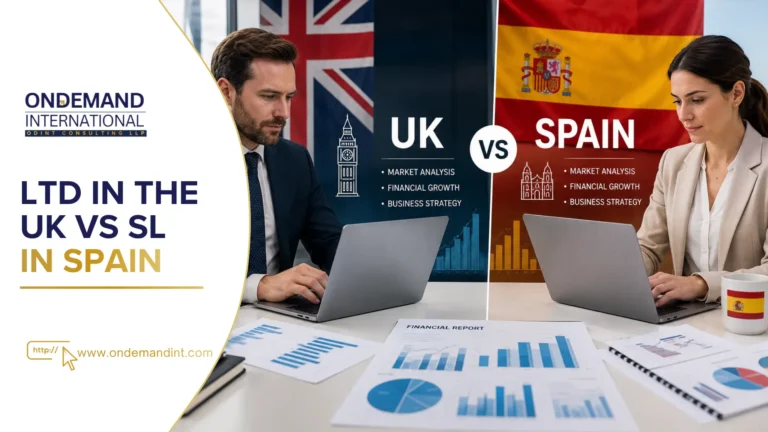


Starting or expanding a business in Europe often leads entrepreneurs to compare Spain vs the United Kingdom. Both destinations offer strong markets, strategic global connectivity, and investor-friendly regulations—but choosing the right jurisdiction depends on taxation, legal structure, hiring, business ecosystem, as well as long-term expansion goals.
Are you an entrepreneur who is confused between expanding your business to Spain or the UK? You’re not alone—many entrepreneurs struggle with choosing the most profitable and stable market for their business.
This guide gives you a clear, side-by-side comparison of the pros and cons of starting a business in Spain vs the UK to help you decide the perfect location where your business will thrive.
Overview: Spain vs the UK for Company Formation
Factor | Spain | United Kingdom |
|---|---|---|
Tax Rate (Corporate Tax) | 23% standard (reduced rates for SMEs and startups) | 25% corporate tax (effective April 2023) |
Market Access | 27-country EU Single Market | Strong global trade, but not part of the EU |
Startup Ecosystem | Supported by the Spanish Startup Law (2023) | Well-established, especially in London & Manchester |
Company Formation Time | 1–3 weeks | 24–72 hours |
Pros and Cons of Companies in Spain vs the UK
Pros of Setting Up a Company in Spain
1. Access to the EU Single Market
Unlike the UK, Spain gives your business direct access to 448 million EU consumers with no trade barriers.
This is crucial for:
- Ecommerce brands
- Logistics & Supply Chain
- SaaS Companies targeting EU markets
- Manufacturing & Export Businesses in Spain
2. New Spain “Startup Law” Benefits
Spain’s Startup Law (2023) introduced major incentives:
- 15% corporate tax for the first 4 years
- Reduced bureaucracy
- Option to get the Spanish Digital Nomad Visa
- Faster NIE and NIF processes
- Support for tech & R&D companies
Read More About CIF And NIF In Spain.
3. Strategic Hub for EU, Africa & LATAM
Spain’s proximity to:
- Europe
- North Africa
- Latin America
makes it ideal for companies that want global expansion.
4. Attractive Residency and Digital Nomad Options
Business owners can obtain:
- Entrepreneur Visa
- Investor (Golden) Visa
- Digital Nomad Visa (DNV)
These residency programs make Spain a strong choice for entrepreneurs relocating with family.
Cons of Setting Up a Company in Spain
1. Bureaucracy & Slower Setup
Spain has a reputation for administrative complexity—banks, tax offices, and notaries often cause delays.
2. Limited English Proficiency
English is improving in business hubs, but Spanish is still essential for smooth operations.
3. Higher Social Security Costs
Spanish employers must contribute approximately 30% of their salary to social security.
Pros of Setting Up a Company in the UK
1. Fastest Incorporation in Europe
The UK offers 24–48-hour company registration, one of the fastest globally.
Setting up a business in the United Kingdom is perfect for:
- Startups needing a quick setup
- Digital companies
- Global entrepreneurs
2. Business-Friendly Legal & Tax Environment
The UK is known for:
- Simple compliance
- Transparent regulations
- Strong contract enforcement
- World-class financial institutions
3. Global Talent Pool
London remains one of the best tech hubs for Artificial Intelligence, fintech, eCommerce and Software development.
4. Powerful International Reputation
A UK-registered company is highly trusted internationally and ideal for global clients, SaaS sales, international banking, and investors.
Cons of Setting Up a Company in the UK
1. No Access to the EU Market Post-Brexit
Companies in the UK no longer enjoy EU single-market access, meaning:
- No free trade
- Complex VAT rules for EU sales
- Increased customs paperwork
2. Rising Corporate Tax: Now 25%
Since 2023, the UK increased corporate tax from 19% → 25%, depending on profit.
3. Banking is Harder for Foreign Directors
Non-residents often face challenges opening UK business bank accounts.
4. Visas Are Expensive
If you want to relocate, UK visas (Innovator/Skilled Worker) are typically more costly than Spain’s DNV & Entrepreneur visas.
Spain vs UK Tax Comparison
Tax Type | Spain | United Kingdom |
Corporate Tax | 23% (15% for startups) | 25% |
VAT | 21% | 20% |
Personal Tax (Top Rate) | 47% | 45% |
Dividend Tax | 19–26% | 8.75–39.35% |
Employer Social Security | ~30% | ~13.8% |
Which Is Better for Your Business?
Spain is one of the best places for company formation in Europe, if you are looking for:
- EU market access
- Startup tax benefits (15%)
- Residency through Digital Nomad Visa
- Access to Spanish + LATAM markets
- Lower costs for R&D & tech teams
You may choose business setup in the UK if you want:
- Fastest incorporation
- Strong global reputation
- Access to investors in London
- Simplified corporate structure
- Flexible labour laws
How can OnDemand International assist you?
At OnDemand International, we help founders incorporate companies worldwide with:
- Full documentation
- Tax registration
- Bank account support
- Visa & residency guidance
- Compliance & bookkeeping
Book your free consultation with our incorporation experts today.
Our experts will guide you on the best jurisdiction based on your business model.
Conclusion
When choosing between Spain and the UK, it ultimately comes down to your business model, taxes, and the way you want to grow your business.
If you want EU market access, low startup taxes, and a route to European residency for the founders of the company, Spain will offer that long-term advantage strategically. The Startup Law in Spain, the Digital Nomad Visa, and access to the 27 nations in the EU all make Spain an attractive option for tech, e-commerce, and service-based companies targeting Europe.
If instead you’re concerned about speed of incorporation, a corporate structure that is recognized internationally, easy hiring within the country, and a robust investor ecosystem, the UK will continue to be very attractive.
If you’re unsure which jurisdiction fits your business, our experts at OnDemand International can guide you based on your industry, tax structure, and international growth plans.
FAQ’s
Should you start a company in Spain or the United Kingdom?
This is going to depend on your goals. For instance, Spain is a better option if you want EU access, tax breaks for startups and residency programs for non-EU citizens. If you want to set something up quickly and you want access to investors and global credibility, the UK is better.
Which country has lower corporate tax, Spain or the United Kingdom?
Spain has a 23% corporate tax rate (but for the first 4 years, you can pay 15% if you’re a startup). The UK’s main corporate tax is 25%. For early-stage companies, Spain can be better in regard to corporate tax.
Is it easier to open a company in Spain or the UK?
The UK is definitely easier and quicker. You can set up a company in 24–48 hours; incorporating a company in Spain takes 1–3 weeks minimum due to the notary and administrative process.
Can non-residents open a company in either Spain or the UK?
Yes, in both Spain and the UK, you are allowed 100% ownership as a foreigner and can be a non-resident director too. However, the processes in Spain may require more documentation, such as an NIE number.
Is Spain still in the EU, and does it have access to the EU market?
Yes, Spain is still in the EU and gives companies access to 448 million consumers inside the Single Market; the UK does not offer EU access anymore due to Brexit.