
Quick Answer: Accounting services in the Netherlands include bookkeeping, VAT returns, payroll administration, annual financial statements, and corporate income tax returns. Dutch businesses must maintain accurate financial records and meet applicable tax and reporting deadlines. The cost depends on the company’s size, transaction volume, and the services required.
Setting up a business in the Netherlands is one thing; managing its finances throughout the year is another. From recording everyday transactions to preparing annual accounts, accounting requires regular attention and a clear understanding of Dutch regulations. For foreign business owners, finding the right accounting support can make these responsibilities easier to manage and leave more time to focus on running the company.
What Are Accounting Services in the Netherlands?
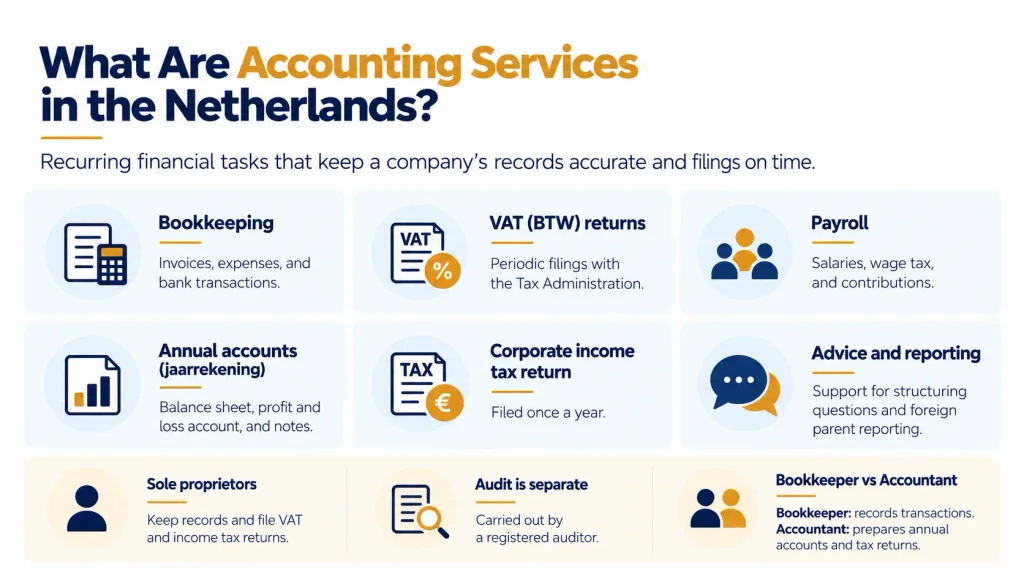
Accounting services in the Netherlands are the recurring tasks that keep a company’s numbers accurate and its filings on time. For a typical BV, they include:
- Bookkeeping: recording invoices, expenses, and bank transactions.
- VAT (BTW) returns: periodic filings with the Tax Administration.
- Payroll: salaries, wage tax, and contributions if you employ people.
- Annual accounts (jaarrekening): balance sheet, profit and loss account, and notes.
- Corporate income tax (vennootschapsbelasting) return: filed once a year.
- Advice and reporting: structuring questions and reporting to a foreign parent.
Sole proprietors also keep records and file VAT and income tax returns, but the annual accounts and corporate tax return apply to companies such as the BV.
An audit is a separate service, because the audit of financial statements must be carried out by a registered auditor. It is also easy to mix up a bookkeeper and an accountant. A bookkeeper records transactions. An accountant prepares the annual accounts and tax returns and advises on them. When you compare providers, check which of these tasks sit inside the quoted price.
What Accounting Obligations Does a Dutch Company Have?
Five obligations matter most for a BV.
- Keep records: Every business must keep and retain its records. The minimum is 7 years, and data on immovable property must be kept for 10 years. The ledger, stock records, and purchase and sales records form the basis for your tax returns.
- File VAT returns: Returns are filed monthly or quarterly, and the standard rate is 21% with a reduced rate of 9%. Very small businesses can opt into the small business scheme (KOR) if annual turnover is below €20,000, but they then cannot reclaim the VAT they pay.
- File annual accounts with the KVK: The directors draw up the accounts within five months of year-end, shareholders have two months to adopt them, and filing follows within eight days of adoption. The same source notes that the 12-month limit is firm and that the law gives no extension for filing. Filing is digital through standard business reporting. Missing the deadline can lead to personal director liability if the company later faces bankruptcy.
- File the corporate income tax return: for a calendar-year company, the return must be filed before 1 June of the following year, and an extension can be requested through a registered tax adviser. The rate is 19% on profit up to €200,000 and 25.8% above that, unchanged for 2026.
- Get an audit only if you are large enough: Companies are sorted into micro, small, medium, and large. A company falls into a size category when it meets two of the three criteria (balance sheet total, net turnover, and average employees) for two consecutive years. Medium and large companies need an audit. The monetary thresholds were raised by 25%, so confirm the current figures with your accountant instead of relying on older articles.
| Obligation | How often | Key rule |
|---|---|---|
| Business records | Ongoing | Keep at least 7 years |
| VAT return | Monthly or quarterly | Depends on your filing frequency |
| Annual accounts (KVK) | Yearly | 8 days after adoption, maximum 12 months after year-end |
| Corporate tax return | Yearly | Normally before 1 June for calendar-year companies |
| Audit | Yearly, if medium or large | Carried out by a registered auditor |
Accounting Services for Foreign Entrepreneurs in the Netherlands
Accounting for foreigners in the Netherlands follows the same rules as for Dutch owners. A few points come up more often when the owner is abroad.
- Tax residence is automatic: A BV incorporated in the Netherlands is treated as a Dutch tax resident, so it files Dutch returns wherever its shareholders live. A foreign company that operates through a Dutch branch or subsidiary is liable for Dutch corporate income tax on the income of that Dutch entity.
- Ownership details are needed: Formation requires a registered office in the Netherlands and a list of shareholders and UBOs. Your accountant will need the same details for filings.
- Language: Tax administration letters and portals are mostly in Dutch. An accountant who handles that correspondence in English saves you time and mistakes.
- Two reporting systems: If a foreign parent consolidates your numbers, tell the accountant early, because year-end dates and formats may differ.
A simplified first year looks like this:
- After registration, the Tax Administration issues your RSIN, corporate tax number, and VAT number.
- Set up cloud bookkeeping before the first invoice.
- File VAT returns each period.
- Close the books at year-end and prepare the annual accounts.
- Adopt and file the accounts, then submit the corporate tax return.
The most common mistakes are leaving bookkeeping until year-end, forgetting that filing is due eight days after adoption, and not telling the accountant about foreign group reporting.
How Much Do Accounting Services in the Netherlands Cost?
There is no standard price list. Any figure quoted before the provider knows your transaction volume should be treated with caution. Fees usually depend on:
- the number of invoices and bank transactions per month
- VAT complexity, for example, EU cross-border sales
- payroll headcount
- foreign currencies and multiple bank accounts
- the state of your records, since catching up on overdue bookkeeping costs more
- extra reporting for a foreign parent
Firms commonly charge a fixed monthly package, an hourly rate for one-off work, or a mix of both. Quotes are only comparable when the scope is the same, so ask each firm:
- How many invoices and bank lines are included each month?
- Are VAT returns, annual accounts and the corporate tax return inside the fee, or extra?
- What is the hourly rate for questions outside the package?
- What would a catch-up of overdue bookkeeping cost?
Also weigh the cost of errors. Late filings can bring penalties and director liability, and rework is billable. A cheap quote that leaves out the annual accounts is not cheap.
How to Choose an Accountant in the Netherlands (Checklist)
Use this list when you compare an accountant in the Netherlands:
- English-speaking team, including written reports and calls with the authorities.
- Experience with foreign-owned BVs, ideally in your sector.
- Written scope and fee, with extras priced.
- KVK filing and the corporate tax return are covered, not only bookkeeping.
- Cloud accounting with direct access to your own numbers.
- Credentials. Ask about membership of a recognised professional body. The NBA is the professional organisation for accountants in the Netherlands.
- A named contact and a stated response time.
- A deadline calendar covering VAT, the corporate tax return and annual accounts.
Red flags are promises of guaranteed tax savings, no written scope, or reluctance to give you access to your own records.
Conclusion
Accounting services in the Netherlands come down to a steady calendar: records kept for seven years, VAT returns every period, annual accounts filed with the KVK, and a corporate tax return each year. For a foreign owner, the best setup is an accountant who speaks your language, knows foreign-owned BVs, and gives you a written scope and deadline calendar.
At OnDemand International, we connect company registration with accounting support, so your books are set up correctly from the first invoice. Contact our team to discuss your plans in the Netherlands. This article is general information, not tax or legal advice.
FAQs
What do accounting services in the Netherlands include?
Usually bookkeeping, VAT returns, payroll, annual accounts, and the corporate tax return. Audit and tax advice are separate or optional services.
How long must I keep business records?
At least seven years, and ten years for data on immovable property.
Can I get accounting services in English as a foreigner?
Yes, many firms serve foreign-owned companies in English. Confirm that this covers written communication and tax correspondence, not only meetings.