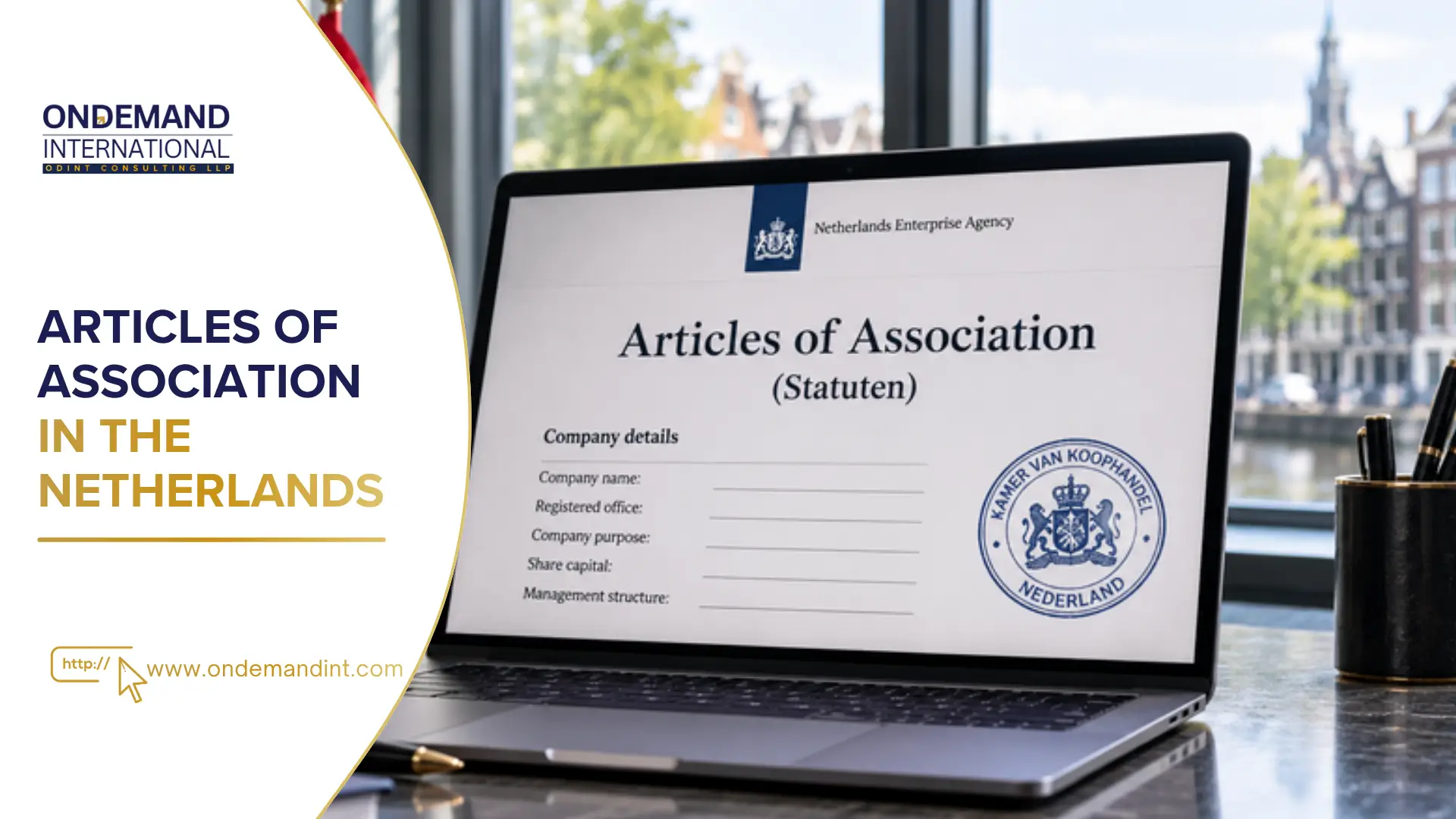
Articles of Association (AoA), known as statuten in Dutch, are the legal rules that govern how a company operates in the Netherlands. They are a part of the notarial deed of incorporation and outline the purpose of the company, the registered office, the structure of management, the rights of the shareholders, and the decision-making process of the company. If you are starting a Dutch Private Limited Company (BV) or Public Limited Company (NV), knowledge about the Articles of Association in the Netherlands is a crucial aspect of the company formation process.
They are the legal documents that govern how the company is managed, director appointments, shareholders’ meetings, and other key business activities. This guide provides an explanation of the role, legal requirements, components, and advantages of Articles of Association in the Netherlands.
What Are Articles of Association?
Articles of Association (AoA), also called statuten in Dutch, are the governing rules of a legal entity in the Netherlands. They define the organisation’s structure, management, and operations. The Articles of Association are part of the notarial deed of incorporation for companies like a Dutch Private Limited Company (BV) and a Public Limited Company (NV).
They outline key features of the company, such as its legal name, registered office, business activities, share structure, and the appointment of directors and the rules for decision-making. They also set out the rights and duties of shareholders and the powers of the company’s governing bodies. The Articles of Association serve as a legal framework that must be followed by the directors, shareholders, and other stakeholders. These are also registered with the Dutch Chamber of Commerce (KVK) and are available to the public.
Why Are Articles of Association Required in the Netherlands?
Articles of Association in the Netherlands are mandatory for establishing legal entities with legal personality, including a Private Limited Company (BV) and a Public Limited Company (NV). They form part of the deed of incorporation, which must be executed before a Dutch civil-law notary.
The Dutch AoA serves several important purposes:
- Defines the Company’s Purpose: The AoA provides a clear description of the company’s goals, its main lines of activity, and the sector it serves.
- Forms the Organizational Structure: The AoA describes the legal framework of the business, including its type (BV or NV), share capitalization, and any restrictions on share transfers.
- Describes Internal Governance: The AoA outlines the duties and responsibilities of the board of directors, the supervisory board, and the shareholders’ meeting, among other governing bodies (if appropriate).
- Defines Decision-Making Processes: The AoA specifies how meetings are called, who is eligible to vote, and what percentage of votes are needed to approve resolutions on important issues.
- Establishes a Framework for Conflict Resolution: The AoA describes how to resolve possible conflicts that may arise between directors or shareholders.
Key Elements of Articles of Association in the Netherlands
The Articles of Association outline the structure, management, and operation of the company in the Netherlands. These contents are specific to the type of company and the requirements. However, most articles of association address the following topics:
1. Company Name and Registered Office
According to the Articles of Association, the company’s official name and registered office are located in the Netherlands. The name must conform to the legal requirements in the Netherlands and contain the proper legal designation, such as BV (Private Limited Company) or NV (Public Limited Company).
2. Company Objectives
This section describes the plan for the company and the business activities that it will pursue. It offers shareholders and directors a clear purpose of the company and the scope of its activities.
3. Share Capital
The Articles of Association outline the structure of the company’s share capital. This can contain the variety and kinds of shares, their nominal values, and the rights of each share class. These details are helpful for companies where there are several shareholders, establishing ownership and voting structure.
4. Management Structure
This section provides information about who runs the company and makes important decisions. It includes the functions of managing directors, the shareholders and, if applicable, a supervisory board. It can also establish their duties and powers to act on behalf of the company.
5. Meetings and Voting Rights
The Articles of Association describe the procedures for shareholders’ meetings and the process for approving decisions. They include topics like how to notify meetings, how people vote, and how many votes are needed to pass a resolution. These rules explain to shareholders how they can be involved in important decisions made in the company.
6. Financial Provisions
This section provides for the financial arrangements of the company, which are the financial year, annual accounts, and distribution of profits. It may also provide information on when dividends may be paid to shareholders and any required approvals before a dividend is paid.
7. Amendments
A company may need to change its Articles of Association as its business or ownership develops. The document describes how these changes can be effected, including the shareholder’s approval needed. In the Netherlands, amendments normally need a notarial deed signed by a Dutch civil-law notary.
8. Dissolution
This section deals with the circumstances in which a company may be brought to an end. It provides for the process of dissolution and liquidation, the settlement of outstanding debts, and the distribution of the remaining assets among the shareholders in the event of a liquidation, in line with Dutch law.
Benefits of Having Clear Articles of Association
Having clear and well-drafted Articles of Association offers a multitude of benefits for your Dutch business:
- Clarity and Transparency: A well-defined AoA avoids ambiguity regarding company structure, decision-making processes, and shareholder rights. This clarity minimises the risk of internal conflicts and disputes.
- Protection for Shareholders and Investors: A comprehensive AoA outlines voting rights, profit distribution, and procedures for handling disputes. This transparency fosters trust and protects the interests of all stakeholders.
- Flexibility: You can create the governance structure and decision-making procedures that best fit your business model by customizing the AoA to meet your unique business demands.
- Streamlined Operations: Effective decision-making procedures and seamless daily operations are guaranteed by the AoA’s explicit rules.
- Enhanced Credibility: Professionalism and adherence to best practices are demonstrated by well-drafted agreements of association (AoAs), and this can be especially appealing to possible partners and investors.
Conclusion
The Articles of Association are an essential part of establishing and managing a legal entity in the Netherlands. They provide the legal framework for a company’s purpose, share structure, management responsibilities, and decision-making procedures. For entrepreneurs establishing a Dutch BV or NV, having clear and properly drafted Articles of Association helps create a sound foundation for business operations.
At OnDemand International, we recognize the pivotal role of Articles of Association in laying the groundwork for business success. Our team of seasoned professionals stands ready to assist you in registering your company in the Netherlands, providing comprehensive support in drafting and filing the requisite documents, including the Articles of Association. Reach out to us right now to start your entrepreneurial adventure in the Netherlands with ease and confidence.
FAQ’s
Can the Articles of Association be amended after registration?
Yes, the Dutch Articles of Association can be amended through a formal process involving shareholder approval and registration with the Dutch Chamber of Commerce. Amendments must comply with legal requirements and shareholder rights.
What happens if there are conflicts or ambiguities in the Articles of Association?
Conflicts or ambiguities in the Dutch Articles of Association might cause miscommunications and conflicts between the parties involved.
Are there any specific requirements for foreign entrepreneurs or investors registering a company in the Netherlands?
Foreign entrepreneurs or investors are subject to the same registration and legal requirements as Dutch residents. Nonetheless, they might have to designate a local representative or take care of a few more tax and regulatory issues.