Do you need a nominee director in Singapore?
Yes. If you are a foreign founder, Singapore law requires at least one locally resident director under Section 145 of the Companies Act.
Can a foreigner be the sole director of a Singapore company?
No. A foreigner cannot be the sole director unless they hold a valid Singapore residency (such as an Employment Pass). Most foreign founders appoint a nominee director to meet this requirement.
What does a nominee director actually do?
A nominee director fulfills the statutory requirement of local directorship but typically does not participate in daily operations. However, they remain legally responsible for compliance under Singapore law.
Foreign entrepreneurs cannot legally incorporate a company in Singapore without appointing a locally resident director. This requirement is not optional — it is a statutory obligation enforced by the Accounting and Corporate Regulatory Authority under Section 145 of the Companies Act.
A nominee director provides a compliant structure that allows foreign founders to establish and operate a Singapore entity without immediate relocation. However, this structure must be carefully managed, as the nominee director retains full legal responsibility for corporate compliance.
What is a Nominee Director?
Under Section 145 of the Singapore Companies Act (Cap. 50), every business is required to have a minimum of one director who is “ordinarily resident” in Singapore.
A Nominee Director is a local resident (Citizen, PR, or EntrePass holder) appointed to satisfy this residency mandate.
While they act on the instructions of the foreign owner, they remain legally accountable for the company’s statutory compliance with ACRA and IRAS.
When is a nominee director used?
A nominee director is typically used when:
- The founder is not residing in Singapore
- The company is being set up remotely
- An Employment Pass has not yet been secured
New 2026 Compliance: The ROND Requirement
As of late 2025, ACRA mandates that all companies maintain a Register of Nominee Directors (ROND).
Authorized Providers: Under the new CSP Act, you must appoint your nominee through a Registered Corporate Service Provider to avoid heavy non-compliance penalties.
Public vs. Private: While the public can see a director is a “nominee,” your personal “Nominator” details remain private in the ACRA Central Register, accessible only to authorities like IRAS and law enforcement.
Need for Nominee Director in Singapore
Here are some reasons why your company needs a nominee director in Singapore:
Comply with local laws
Every Singapore company must appoint at least one director who is ordinarily resident in Singapore under Section 145 of the Companies Act. Regulatory and legal impacts can occur if you fail to meet compliance.
Establish a local presence
Having a Singapore nominee director with a registered address in key business districts like Raffles Place, Tanjong Pagar, or the Downtown Core signals stability to local banks and the Accounting and Corporate Regulatory Authority (ACRA).
Access to local expertise
A nominee director can provide valuable insight into the local market, culture, and regulations, helping your company navigate these unfamiliar territories.
Protect your privacy
By appointing a nominee director, your company can maintain confidentiality and privacy, as the nominee director’s name will appear on public records rather than your own.
Flexibility in managing your company
The nominee director can hold shares in the company on behalf of the foreign owner, giving the owner flexibility in managing the company without being physically present in Singapore.
Procedure to Appoint a Nominee Director in Singapore
The appointment of a nominee director involves three key steps:
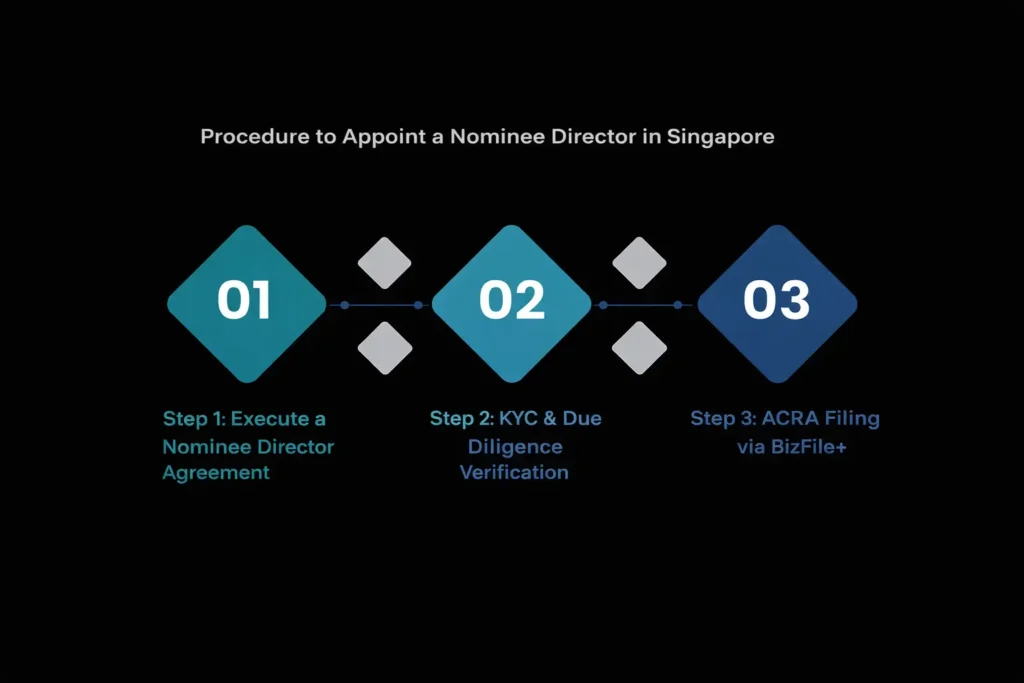
1. Execute a Nominee Director Agreement
A formal agreement is signed outlining duties, liabilities, indemnity clauses, and control mechanisms.
2. KYC & Due Diligence Verification
The service provider conducts mandatory KYC checks on the client to comply with Singapore regulations.
3. ACRA Filing via BizFile+
The nominee director is officially appointed by filing the required details with ACRA.
Eligibility Criteria for Appointing a Nominee Director in Singapore
In Singapore, there are certain eligibility criteria that should be met in order to appoint a nominee director.
Here are the main requirements:

Should be a Singapore citizen or permanent resident
The nominee director should possess a local residence in Singapore and hold either citizenship or permanent residency.
Should not possess a criminal record
The nominee director should possess a clean criminal record and not be disqualified from holding any directorship positions.
Should possess a Singapore residential address
The nominee director should possess a Singapore residential address for official correspondence.
Should be at least 18+ years old
The nominee director should be 18 years old to be qualified for the position.
Should possess relevant experience and knowledge
The nominee director should have relevant business experience and knowledge of local regulations, as they will be responsible for ensuring that the company complies with all relevant laws.
OnDemand International will take care of all the due diligence to make sure all the criteria are met for the ideal nominee director in Singapore.
Roles & Responsibilities of Singapore’s Nominee Director
The roles and responsibilities of a nominee director in Singapore include:
Compliance with local laws and regulations
The nominee director is responsible for ensuring that the firm operates in compliance with local laws and regulations. This includes filing annual returns, holding annual general meetings, and maintaining proper accounting records.
Providing a local address
The nominee director provides a local address for the company, which is required by law.
Representing the company
The nominee director represents the company in Singapore and may be required to sign documents on behalf of the company.
Maintaining proper records
The nominee director is responsible for maintaining proper records of the company’s transactions and ensuring that these records are kept up to date.
Acting in the best interests of the company
The nominee director has a fiduciary responsibility to operate in the best interests of the firm and its shareholders.
Disclosing conflicts of interest
If the nominee director has a conflict of interest, they must disclose it to the board of directors and abstain from any decision-making relating to that conflict.
Reporting to the board of directors
The nominee director is required to report to the board of directors on the company’s operations and financial performance.
Liability for breach of duties
The nominee director can be held liable for breach of their duties as a director, including breaches of fiduciary duty, negligence, or fraud.
Risks of Appointing a Nominee Director in Singapore
While appointing a nominee director in Singapore can be an effective way for foreign companies to establish a local presence and comply with local laws and regulations, there are some risks involved.
Some of the potential risks of appointing a nominee director in Singapore include:

Legal and regulatory risks
The nominee director is responsible for ensuring that the company operates in compliance with local laws and regulations. If the company violates any laws or regulations, the nominee director may face legal and regulatory risks, including fines, penalties, or even imprisonment.
Reputational risks
If the company is involved in any unethical or illegal activities, the nominee director’s reputation may be affected, and they may face damage to their professional standing.
Financial risks
The nominee director may be held personally liable for any financial losses suffered by the company as a result of their negligence or breach of duty.
Conflict of interest risks
If the nominee director has a conflict of interest, such as having a personal or financial interest in a decision made by the company, they may face legal and reputational risks if they fail to disclose it.
Difficulty in managing relationships
In some cases, the relationship between the nominee director and the foreign company may become strained, particularly if there are disagreements over management decisions or issues relating to corporate governance.
It is important for foreign companies to carefully vet potential nominee directors and ensure that they have the necessary expertise and experience to fulfil their roles and responsibilities effectively.
Difference Between A Nominee Director And A Regular Director In Singapore
| Feature / Criteria | Nominee Director (2026 Compliance) | Regular / Executive Director |
|---|---|---|
| Primary Mandate | Statutory Residency Requirement (Sec. 145) | Operational Management & Growth |
| Control & Authority | Typically does not participate in daily management but retains statutory voting rights and fiduciary duties under Singapore law. | Full. Directs daily company affairs. |
| Residency Status | Must be a Singapore Citizen or PR. | Can be Local or Foreign resident. |
| 2026 Legal Status | Must be appointed via Registered CSP. | Can be a private, direct appointment. |
| Public Disclosure | Flagged as “Nominee” in BizFile+ records. | Listed as a standard “Director.” |
| Fiduciary Duty | High. Legally liable for local compliance. | High. Liable for business & compliance. |
| Voting Power | Restricted by Service Agreement. | Active Voting Rights in Board Meetings. |
What Makes a Nominee Director Different from a Nominee Shareholder?
A nominee director acts on behalf of the company owner as a director. A nominee shareholder is a person who “lends their names” to you to allow you to become the registered owner of shares in a company. A nominee shareholder holds shares only for your benefit.
Nominated shareholders are appointed by companies to act as the shareowners. The arrangement remains secret. You retain all rights associated with holding shares. These include the right to vote at general meetings and to receive dividends.
It is possible for the nominee director to be the same person as the nominee shareholder. Let’s say that a nominee shareholder must be another person. These people are often close friends or relatives of the business owner, as well as other professionals such as accountants or lawyers.
Singapore does not have any laws against shareholder agreements with nominees as long as the following:
- Legal reasons prompted the arrangement.
- Public agencies such as the Accounting and Corporate Regulatory Authority of Singapore and the Inland Revenue Authority of Singapore (IRAS), record the identity and existence of beneficial owners (you and/or the business owner).
Is it possible to replace the Nominee Director of a Company in Singapore?
Yes, it is possible to replace a Nominee Director of a company in Singapore. The process typically involves the following steps:
Steps to Replace a Nominee Director in Singapore
1. Check the Service Agreement:
If the Nominee Director was appointed through a service provider, review the contract terms regarding resignation and replacement.
2. Appoint a New Nominee Director:
- The company must ensure that the new Nominee Director meets the residency requirements (must be a Singapore citizen, PR, or pass holder with a local address).
- The new nominee director must sign a Nominee Director Agreement to confirm their limited role.
3. Resignation of the Existing Nominee Director:
- The current nominee director submits a resignation letter to the company.
- The company should acknowledge the resignation and process the necessary changes.
4. Update the Company’s Records:
The company must update the Accounting and Corporate Regulatory Authority (ACRA) through BizFile+ within 14 days of the director’s resignation and replacement.
5. Update the Bank & Other Authorities (if needed):
If the Nominee Director was listed in bank accounts or other official documents, these need to be updated.
Key Considerations:
- The company must always have at least one local resident director at all times to comply with the Companies Act.
- If the nominee director was acting under a service agreement, the provider may require prior notice before replacing them.
- If the company fails to appoint a new nominee director, it could face non-compliance penalties from ACRA.
Conclusion
As Singapore continues to attract entrepreneurs and corporations from around the world, the role of nominee directors will remain essential in facilitating international business transactions and promoting economic growth.
By understanding the responsibilities and obligations of a nominee director, foreign entities can successfully navigate the complexities of setting up a business in Singapore and thrive in one of the most dynamic and prosperous business environments in the world.
However, the role of a nominee director should not be taken lightly; that’s why it is advisable to seek the assistance of professional experts from OnDemand International to help you appoint a nominee director in Singapore.
FAQ’s
Why do foreign companies appoint nominee directors in Singapore?
Foreign companies appoint nominee directors in Singapore to comply with the local law that requires every Singapore company to possess a minimum of one director who is ordinarily resident in Singapore.
What happens if a company gets an uncooperative director as a local nominee?
Companies are often forced to replace their Nominee Director because they are no longer cooperative with clients or not accessible. We as corporate service providers must communicate clearly with our clients and explain to them the responsibilities and scopes of nominee directors.
Who can become a nominee director in Singapore?
Nominee directors will be hired to comply with Singapore law. They must be 18+ citizens or permanent residents of Singapore with a permanent Singapore address.
Can a nominee director be held liable for the actions of the foreign company?
Yes, if a nominated director is discovered to have participated in fraudulent activity, broke their fiduciary obligations, or acted carelessly, they may be held accountable for the foreign company’s actions.
How can foreign companies protect themselves when appointing a nominee director in Singapore?
Foreign companies can protect themselves when appointing a nominee director in Singapore by conducting thorough due diligence, ensuring that the nominee director has the necessary experience and expertise, having appropriate insurance coverage, and regularly reviewing the nominee director’s performance.
Can a nominee director be removed from their position?
Yes, a nominee director can be removed from their position by the foreign company that appointed them.
Can a Foreigner Be a Director in a Singapore Company?
Yes, a foreigner can be appointed as a director of a Singapore company. However, under Section 145 of the Companies Act, every company must have at least one director who is ordinarily resident in Singapore.
A foreigner may serve as an additional director but cannot be the sole director unless they hold a valid Singapore pass and are considered ordinarily resident. Most foreign founders therefore appoint a nominee director to meet the statutory requirement.