
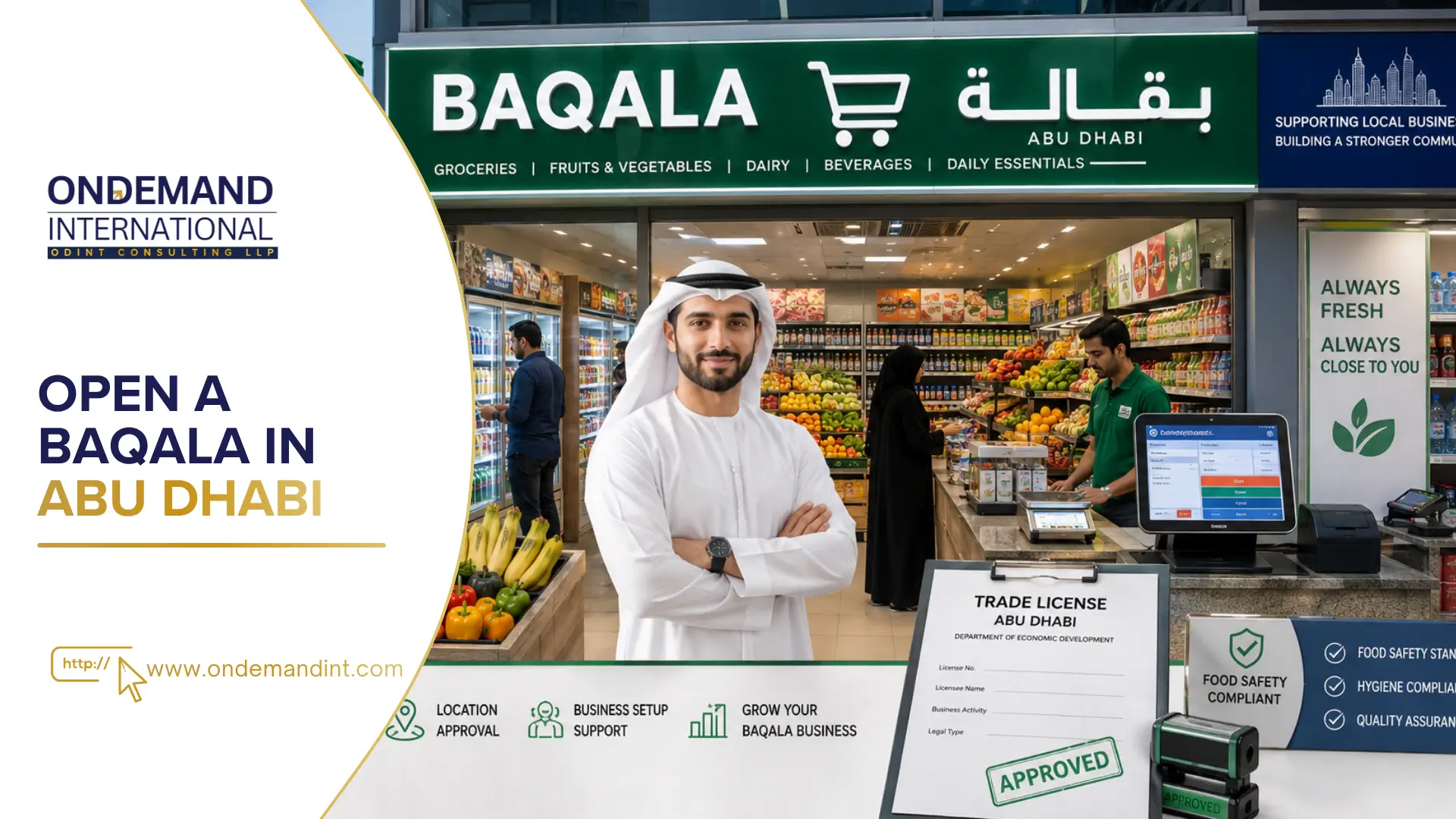
Opening a baqala in Abu Dhabi requires obtaining a commercial trade license from the Abu Dhabi Department of Economic Development (DED), municipality approvals, food safety clearances, and compliance with Project Baqala regulations. As one of the UAE’s fastest-growing retail segments, baqalas continue to play a critical role in neighbourhood grocery retail across Abu Dhabi, offering entrepreneurs a relatively low-barrier entry into the UAE’s food and convenience store industry.
Whether you are a UAE resident or a foreign investor looking to start a grocery business in Abu Dhabi, understanding the legal structure, licensing process, municipality requirements, and operational compliance obligations is essential before launching your store.
In this guide, the UAE business setup experts at OnDemand International explain everything you need to know to open a baqala in Abu Dhabi — including licenses, ownership rules, setup costs, food safety requirements, and the exact step-by-step registration process for 2026.
What is a Baqala? Understanding the Concept
The word “baqala” (بقالة) is Arabic for a small grocery store, traditionally one that sells everyday essentials — fresh produce, dairy, canned goods, beverages, household items, and snacks. In Abu Dhabi, the term has taken on a far more specific and regulated meaning.
In 2013, the Abu Dhabi Food Control Authority (ADFCA) launched Project Baqala, a landmark initiative to standardize all small grocery retail outlets across the emirate under a unified brand identity, safety framework, and hygiene standard. Under this initiative, every qualifying grocery store must display the “Baqala” name prominently, adopt approved store layouts, meet food safety protocols, and dress staff in uniforms.
The initiative is directly aligned with the Abu Dhabi Vision 2030, which prioritizes a clean, safe, and organized retail environment for residents. For entrepreneurs, this means opening a baqala in Abu Dhabi is not just a business decision — it is an entry into a government-standardized retail ecosystem.
Why Open a Baqala Business in Abu Dhabi Right Now?
The Abu Dhabi grocery retail market continues to grow at a pace that few sectors can match. Baqalas currently account for more than 81% of all grocery retailers across the UAE, and the national grocery market is on track to exceed $40 billion in value. Here is why now is a strong time to enter:
- High Consumer Demand: Nearly 59% of Abu Dhabi shoppers prefer neighbourhood baqalas due to their proximity to home or workplace — a structural advantage no supermarket can fully replicate.
- Low Entry Barriers Relative to Return: Compared to restaurants or cafes, the startup investment for a baqala is relatively modest, and recurring costs such as rent and inventory are highly manageable for first-time entrepreneurs.
- Extended Hours = Competitive Edge: With many baqalas operating late into the evening or around the clock, store owners can serve customer segments that larger retailers miss — especially in residential clusters, labour accommodations, and dense urban neighbourhoods.
- Government-Supported Standardization: Project Baqala has not only improved hygiene and quality across the sector — it has helped reduce operational inconsistencies, giving compliant store owners a more level playing field.
Licenses and Compliance Requirements to Open a Baqala in Abu Dhabi
This is the most critical section for any prospective baqala owner. Failing to obtain the correct licenses or meet compliance requirements can lead to delays, fines, or forced closure. Here is a breakdown of every key requirement:
1. Commercial Trade License from Abu Dhabi DED
The foundation of your baqala’s legal existence is a Commercial Trade License issued by the Abu Dhabi Department of Economic Development (DED). When applying, you must specify the business activity as “Grocery” or “Retail Sale of Food and Beverages.” You will also be required to submit a detailed inventory list of all products you intend to sell. Any subsequent addition of new product categories requires DED approval and an update to this list.
2. Business Structure and Ownership
You must select a legal business structure before registration. Common options include:
- Sole Proprietorship (Sole Establishment): Suited for single-owner operations, but if the owner is a foreign national, a Local Service Agent (LSA) may be required.
- Limited Liability Company (LLC): If structured as a partnership, at least one partner must be a UAE national holding the required equity share in accordance with current Abu Dhabi mainland regulations.
It is worth noting that under the UAE’s updated commercial companies law, 100% foreign ownership is now permissible in a wider range of business activities — speak with a business setup consultant to confirm whether this applies to your specific baqala setup.
3. Abu Dhabi Municipality Approvals
Separate from the DED license, you will need approvals from the Abu Dhabi City Municipality, particularly for:
- Food handling and food safety compliance
- Store fit-out and layout approval (to ensure adherence to Project Baqala standards)
- Health and hygiene certification
- Fire safety compliance (working fire extinguishers, emergency exits, etc.)
4. Food Handling Permit
If your baqala sells perishable goods, prepared foods, or chilled/frozen products, a dedicated Food Handling Permit from the relevant Abu Dhabi food safety authority is mandatory. This requires store staff to complete approved food safety and hygiene training.
5. Trade Name Registration and Baqala Branding Compliance
Your store name must be registered with the Abu Dhabi DED. Under Project Baqala rules, “Baqala” must appear prominently on the signage, with your individual store name displayed in a smaller typeface. Independent stores not affiliated with a registered retail chain must use the standardized Baqala logo as part of their external branding. Non-compliance with this branding mandate can result in penalties.
6. Signage and Environmental Compliance
- All outdoor air conditioning units must be enclosed in approved, vented aluminum cages.
- Glass storefronts require secure aluminum frames with weatherproofing sealants.
- Store entrances must be free of obstructive promotional material that blocks visibility.
7. Ongoing Compliance and License Renewals
Licenses are not a one-time obligation. You must:
- Renew your DED trade license annually
- Undergo periodic health inspections by Abu Dhabi Municipality
- Keep food handling certifications current
- Maintain VAT registration if turnover exceeds the applicable UAE threshold
Quick Overview of the Setup Process
Opening a baqala in Abu Dhabi typically involves business registration with Abu Dhabi DED, municipality approvals, food safety clearances, commercial tenancy registration, and compliance with Project Baqala operational standards.
Depending on the location, business structure, and fit-out readiness, the setup process usually takes between 3 and 6 weeks.
Step-by-Step Process to Open a Baqala in Abu Dhabi
The process to open a baqala in Abu Dhabi is discussed below:
Step 1: Conduct Market Research and Write a Business Plan
Before engaging with any government authority, assess the competitive landscape in your target neighbourhood. Identify gaps in existing Baqala Abu Dhabi coverage, understand your customer demographics, and prepare a realistic financial plan covering rent, staffing, inventory, and licensing.
Step 2: Choose and Register a Trade Name
Select a compliant trade name and verify its availability through the Abu Dhabi DED portal. Ensure it meets UAE naming conventions (no offensive terms, no names of existing registered companies).
Step 3: Determine Business Structure and Ownership
Decide on your legal structure — sole establishment or Limited Liability Company — and, if applicable, identify an Emirati partner or appoint a Local Service Agent. This step often determines the timeline and complexity of the rest of the process.
Step 4: Secure a Compliant Business Location
Choose a commercial space in a zone that permits grocery retail activity. Critically, Abu Dhabi regulations require a minimum distance of 5,000mm (5 metres) between your baqala and the nearest existing baqala to prevent market saturation. Verify zoning compliance with the municipality before signing any lease.
Step 5: Apply for the Commercial Trade License
Submit your application to the Abu Dhabi DED with the required documentation: passport copies, tenancy contract (Ejari/Tawtheeq), floor plan, product inventory list, and partner/LSA details where applicable.
Step 6: Obtain Municipality Approvals and Food Safety Permits
Once the initial DED approval is secured, apply for Abu Dhabi Municipality’s fit-out permit and food safety/health certifications. Have your store designed in line with Project Baqala layout guidelines before submitting for inspection.
Step 7: Fit Out the Store and Recruit Staff
Fit out the store to meet all hygiene, safety, and branding standards. Hire staff, register them under your company’s visa quota, and ensure all food-handling employees are trained and certified.
Step 8: Install POS and Accounting Systems
UAE law requires that physical invoices or printed receipts be provided for all retail transactions. Install a compliant point-of-sale (POS) system and set up a business accounting system for VAT filing and financial tracking.
Step 9: Open a Business Bank Account
A corporate bank account in your business’s name is necessary for all financial operations. Most UAE banks require a valid trade license and Emirates ID to open a business account.
Cost of Opening a Baqala in Abu Dhabi
The total investment to open a baqala in Abu Dhabi varies depending on location, store size, and product range. Key cost components typically include:
- DED Trade License fee: Varies by activity and structure
- Abu Dhabi Municipality approvals and food permits: Separate fees applicable
- Store rent: Varies significantly by emirate zone and district
- Store fit-out: Subject to size and design scope
- Initial inventory: Depending on product mix and supplier agreements
- Visa and staff costs: Subject to the number of employees and residency processing
- Miscellaneous (POS system, signage, accounting software): Variable Because these variables differ for every business, OnDemand International recommends a tailored cost assessment before you commit to any location or structure.
Can a Foreigner Open a Baqala in Abu Dhabi?
Yes — foreigners can open a baqala in Abu Dhabi, but the structure of ownership depends on applicable UAE mainland regulations and the chosen business type. In many cases, an LLC with an Emirati partner or a sole establishment with a Local Service Agent remains the practical route for expatriates.
With updated UAE commercial laws expanding the scope of 100% foreign-owned activities, it is worth verifying your eligibility with a qualified consultant before assuming a sponsorship arrangement is required.
Conclusion
The cost of obtaining a small business license in Dubai depends on several factors, including the type of business activity, jurisdiction, visa requirements, office setup, and annual compliance obligations. While free zones offer affordable entry points for freelancers, consultants, and digital businesses, mainland structures are often better suited for companies targeting direct UAE market access and long-term expansion.
Instead of focusing only on the cheapest option, businesses should choose a setup that aligns with their operational model, scalability goals, banking requirements, and compliance strategy. Evaluating factors such as commercial activity, office needs, visa eligibility, and renewal costs is essential before incorporation.
A properly structured business setup minimizes operational challenges, reduces unnecessary costs, and creates a strong foundation for sustainable growth in the UAE.
If you are planning to start a business in Dubai, consult the experts at OnDemand International for tailored guidance on selecting the right license and business structure for your expansion goals.
FAQ’s
What is the difference between a baqala and a regular grocery store in Abu Dhabi?
A baqala in Abu Dhabi is a government-regulated small grocery store that must comply with Project Baqala standards, including approved branding, store layout, food safety protocols, and hygiene certification. A generic grocery store not enrolled in the scheme cannot legally use the Baqala identity.
What license do I need to open a baqala in Abu Dhabi?
You need a Commercial Trade License from the Abu Dhabi DED, along with food handling permits, Abu Dhabi Municipality health and safety approvals, and Project Baqala branding compliance.
How long does it take to open a baqala in Abu Dhabi?
With all documents in order, the process typically takes between 3 and 6 weeks, depending on the speed of municipality approvals and store fit-out readiness.
Is there a minimum distance requirement between two baqalas in Abu Dhabi?
Yes. Abu Dhabi regulations require a minimum separation of 5,000mm between any two baqalas to prevent over-saturation in a given area.
Do I need to renew my Baqala license every year?
Yes. Your DED trade license must be renewed annually, and food safety certifications and municipality approvals must remain current to avoid penalties or closure.