What are the best businesses to start in Netherlands?
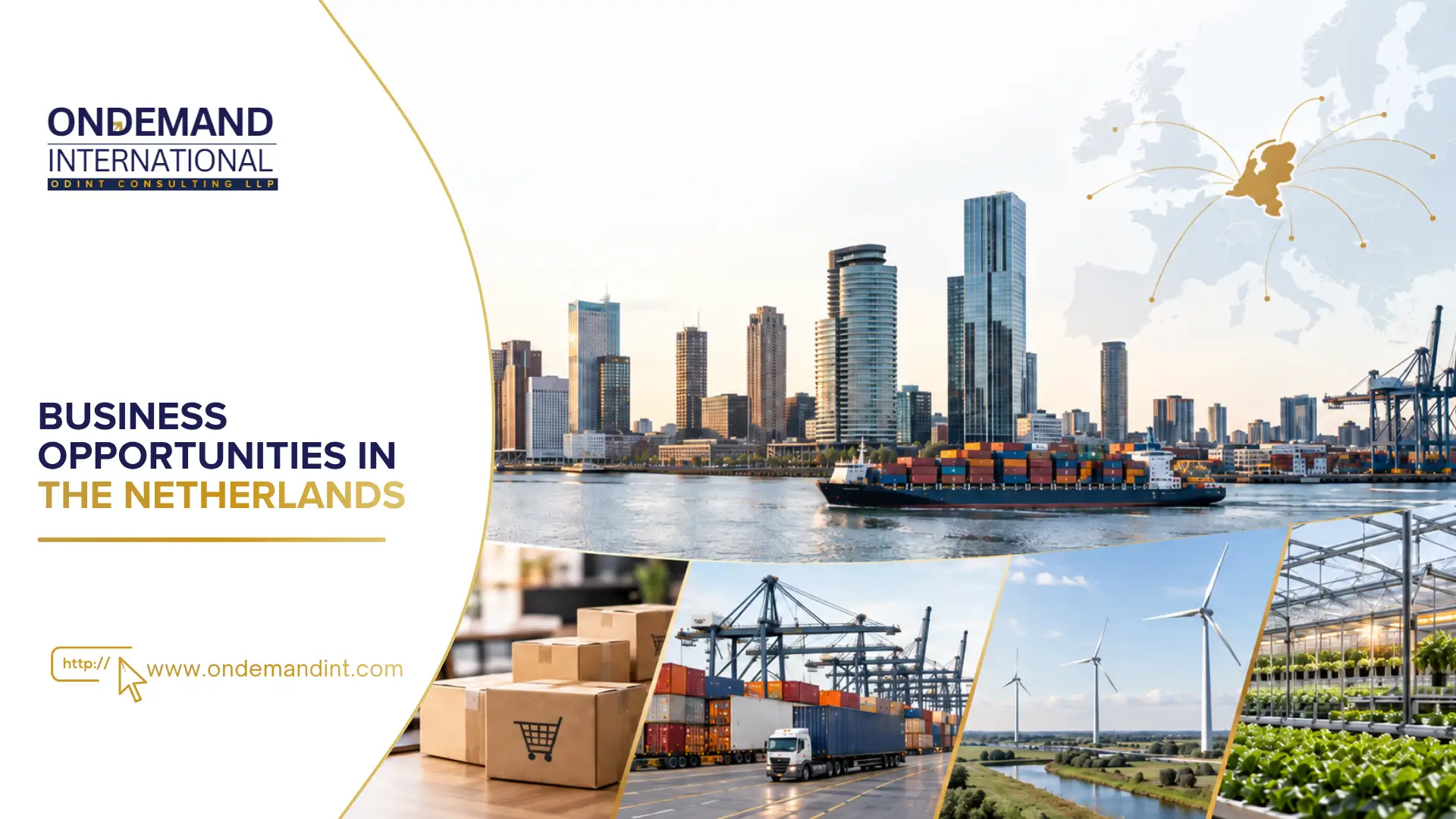
The best businesses to start in the Netherlands in 2026 include IT services, e-commerce, logistics, import-export, renewable energy, AgriTech, and compliance consultancy. Foreign entrepreneurs usually choose these sectors because of the Netherlands’ access to the EU market, advanced infrastructure, and international workforce.
Registering a Dutch company starts with an €85.15 government filing fee — but that number alone won’t get you a working business. Once you factor in notarization, documentation, translation, and the compliance work most foreign founders can’t navigate alone, a properly set-up Netherlands company typically runs €3,000–€5,000 all-in with full-service support. What that investment buys you: direct access to 452 million people across the EU, Europe’s busiest port, and an economy that just climbed to 8th place globally for competitiveness.
That combination is why the Netherlands keeps showing up on shortlists for foreign entrepreneurs — not because of tulips, but because the numbers genuinely work. Here are 10 sectors where they work best right now, what each one actually costs to get into, and how to register one as a foreign founder.
Why Are Foreign Entrepreneurs Investing in the Netherlands?
- Genuine top-10 economy. The Netherlands ranked 8th in the 2026 IMD World Competitiveness Ranking — up two places from 2025 — scoring especially well on international trade (4th) and technological infrastructure (5th). (Source: IMD World Competitiveness Center)
- Your gateway to 452 million consumers. Between the Port of Rotterdam, Schiphol Airport, and EU-wide free movement of goods, a Dutch base connects you to the entire EU market — 452 million people as of January 2026. (Source: Eurostat)
- Government money is genuinely on the table. From the SDE++ subsidy for green energy projects to the Startup Visa for innovative non-EU founders, the Dutch government backs entrepreneurship with real programs, not just friendly rhetoric.
- Registration that doesn’t need a lawyer’s retainer. The KvK fee is €85.15. A standard BV (private limited company) typically runs €1,200–€2,500 all-in with notary fees, rising to around €3,500 for foreign-founder structures needing extra documentation. (Source: KvK.nl, 2026)
Business Opportunities in the Netherlands: Quick Comparison
| Business Idea | Investment Needed | Profit Potential | Setup Difficulty | Best For |
|---|---|---|---|---|
| E-commerce | Low–Medium | Medium–High | Easy | First-time founders |
| Agriculture / AgriTech | Medium–High | Medium | Moderate | Sector specialists |
| Information Technology | Low–Medium | High | Moderate | Tech founders |
| Jewellery | Low–Medium | Medium | Easy | Craft entrepreneurs |
| Spices & Specialty Foods | Low | Medium | Easy | Import-export traders |
| Real Estate | High | Medium–High | Complex | Capital-backed investors |
| Import-Export | Medium | Medium–High | Moderate | Trade-focused founders |
| Renewable Energy & Green-Tech | High | High (long-term) | Complex | Sustainability investors |
| Logistics & Fulfillment | Medium–High | Medium–High | Moderate | Rotterdam-adjacent traders |
| Business & Compliance Consultancy | Low | Medium–High | Easy | Cross-border specialists |
1. E-commerce Business
Dutch online shoppers are about as digitally native as it gets — internet penetration in the Netherlands runs close to 98%. (Source: Eurostat) That makes e-commerce one of the lowest-friction ways to enter the market: launch a store around a niche Dutch product (specialty cheeses, sustainable fashion, craft beer), optimize for Dutch-language SEO, and lean on the country’s dense delivery infrastructure for fast fulfillment.
Setup cost is low relative to most ideas on this list, since you’re not carrying physical premises. Register your e-commerce business in the Netherlands to see the exact structure that fits.
2. Agriculture & AgriTech
The Netherlands is the world’s second-largest agricultural exporter by value despite its small size — a testament to how seriously it takes agricultural innovation. Vertical farming, precision agriculture, and organic/speciality crops (berries, ancient grains) are where the government’s agritech subsidies are concentrated. This is a higher-investment idea — land, equipment, and compliance add up — but it’s backed by some of the most advanced farming R&D in the world.
3. Information Technology
The Netherlands ranked 5th globally for technological infrastructure in the 2026 IMD ranking, and Amsterdam’s tech scene backs that up with real venture activity. Software development, cybersecurity, AI, and fintech are the sectors seeing the most government-backed digital transformation initiatives. Setup costs are modest — mostly your own runway — and the talent pool is deep and largely English-speaking. Set up your IT company in the Netherlands, and you’re positioned inside one of Europe’s strongest tech infrastructures.
4. Jewellery Business
Dutch consumers pay for craftsmanship, and there’s real room for contemporary, handcrafted, or upcycled jewellery brands — particularly ones built around sustainable materials or personalization, both of which resonate strongly with Dutch buying habits. This is one of the lowest-capital ideas on the list: a workshop, materials, and an online storefront can get you started without major upfront risk. See the full setup guide for a jewellery business in the Netherlands.
5. Spices & Specialty Foods
The Netherlands’ trading history and diverse population (expats, culinary enthusiasts, a genuinely international restaurant scene) create steady demand for imported spices and specialty ingredients. It’s also one of the most capital-light businesses here — you’re sourcing and distributing, not manufacturing. Learn how to set up a spices business in the Netherlands, or if food service interests you more, see our guide to starting an Indian restaurant in the Netherlands.
6. Real Estate
Dutch housing has held up as one of Europe’s more stable property markets, with real demand in sustainable housing, co-living spaces, and senior living as the population ages. This is the highest-capital idea on this list and the most regulation-heavy — but also carries some of the strongest long-term profit potential if you’re already capital-backed. Explore what it takes to set up a real estate business here.
Not sure which of these fits your budget and background? Book a free consultation, and we’ll walk through which structure and sector make sense for you specifically — not just what’s trending.
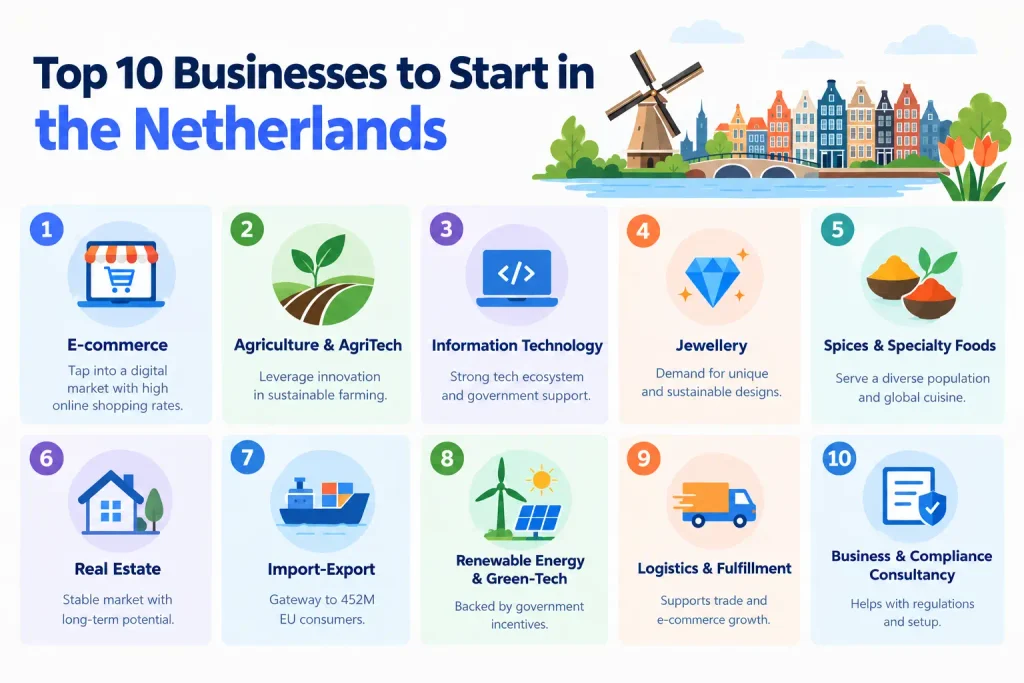
7. Import-Export Business
This is where the Netherlands’ geography does the heavy lifting. The Port of Rotterdam handled 428.4 million tonnes of cargo in 2025 — more than any other port in Europe, and the 11th-highest volume in the world. (Source: Port of Rotterdam Authority) Whether you’re importing niche products with Dutch demand or helping Dutch producers export abroad, the logistics infrastructure removes most of the friction that slows trading businesses down elsewhere. Get the full import-export setup guide.
8. Renewable Energy & Green-Tech
The Dutch government has committed to roughly 21 GW of offshore wind capacity by 2030 — enough to cover about 75% of the country’s current electricity consumption — backed by the SDE++ subsidy, which guarantees a floor return when market electricity prices dip. (Source: NedZero) That level of government commitment makes solar installation, energy-efficiency consulting, and EV-charging infrastructure genuinely well-supported businesses, not just trend-chasing. Expect a higher capital bar and a longer runway to profitability than most ideas here — but also less competition.
9. Logistics & Fulfillment
Rotterdam’s scale (14.2 million TEU of containers moved in 2025) supports a whole ecosystem beyond the port itself: third-party fulfillment, customs brokerage, freight forwarding, and last-mile delivery for the e-commerce boom. (Source: Eurostat) This pairs naturally with the import-export idea above if you’re already thinking about trade.
10. Business & Compliance Consultancy
Every foreign entrepreneur on this list faces the same friction: KvK registration, BSN applications, VAT setup, UBO filings, sector licensing. That complexity has created steady, recurring demand for consultancies that specialize in Dutch market-entry and compliance — a low-capital, relationship-driven business if you have the expertise to back it up.
Conclusion
Choosing the right business opportunity in the Netherlands depends on your investment capacity, professional background, target customers, and long-term goals. Foreign entrepreneurs often choose the Netherlands because of its EU access, international infrastructure, and established business environment. Before incorporation, evaluate the sector requirements, compliance obligations, and suitable company structure.
OnDemand International has helped foreign entrepreneurs register companies across the Netherlands and 13 other jurisdictions — if you already know which idea fits, talk to our team about what registration looks like for your specific case.
FAQs
Why is the Netherlands a good choice for starting a business?
The Netherlands offers a strong economy, strategic location as a gateway to Europe, a skilled and multilingual workforce, and a business-friendly climate. Its high quality of life and focus on sustainability make it an ideal place for entrepreneurs to thrive.
Which industries have strong business opportunities for foreign entrepreneurs in the Netherlands?
Industries with strong opportunities include e-commerce, agriculture, IT, jewellery, spices, real estate, education, import-export, digital nomad services, renewable energy, logistics, and business consultancy. Each sector offers unique opportunities, especially for innovative and sustainable ventures.
What makes the Netherlands a strategic location for an import-export business?
The Netherlands boasts world-class transportation infrastructure, including the Port of Rotterdam — Europe’s largest port — and Schiphol Airport, connecting businesses to over 452 million people across the EU.
What opportunities exist in the Dutch IT sector?
The IT sector in the Netherlands is thriving, with opportunities in software development, cybersecurity, AI, and fintech. The Dutch government supports tech initiatives, making it a hotspot for innovation.