
While performing its main functions as a tax advisor for the government and collecting taxes, IRAS has ensured competitive tax levels along with making the process of tax collection easier.
These measures, in turn then provided a boost to the Singaporean economy as taxes collected by the body contribute significantly to social and economic programs of the country.
IRAS with its digital access has brought ease in the burden of tax reporting for companies incorporated in Singapore and for residents of the country. Along with it, IRAS has also aided in drafting tax agreements that prevent citizens from getting taxed twice and thus help in reducing their economic burdens.
In this article, we will discuss the Inland Revenue Authority of Singapore (IRAS) in more detail and its various roles and responsibilities. So, without any further ado, let’s jump into it.
WHAT IS IRAS?
IRAS, also known as the Inland Revenue Authority of Singapore is a regulatory body under the Ministry of Finance of the Government of Singapore that deals with the collection of taxes and also acts as a chief tax advisor to the government.
THE ROLE AND RESPONSIBILITIES OF THE IRAS
Any question pertaining to taxes that an individual, a company, or even a country might have on this subject is dealt with by the Inland Revenue Authority in Singapore. However, the two primary functions performed by the authority are broadly classified as collecting all types of taxes and acting as a chief tax advisor to the government of Singapore.
1. Collection of taxes
While performing the central role of a tax collection body, IRAS collects the following types of taxes –
- Income tax — a tax charged on the income of individuals and companies.
- Goods and Services Tax (or GST) — a value-added tax levied which is levied on imports as well as on the consumption of goods and services. It’s usually included in the price and charged by the supplier of goods and services.
- Property Tax — applied to all property owners, based on the expected rental value of the properties.
- Stamp Duty for Property
- Stamp Duty for Property-Holding Entities
- Stamp Duty for Shares
- Withholding Tax
- Trust
- Estate Duty
- Private Lotteries Duty
- Betting and Sweepstakes Duties
- Casino Tax
- Clubs and Associations
- Charities
- Dividends, capital gains and inheritance are not to be taxed.
IRAS constitutes a major support to the country’s economic and social programs as taxes collected by the governing body account for about 70% of the government’s operating revenue, a large sum of which goes to these programs and initiatives.
2. Functioning as the chief tax advisor
IRAS, with its second role as chief tax advisor to the government, also performs tasks which include drafting the tax policies, aid Finance ministry in drafting tax legislation and helping in drawing tax treaties for the country. For example, Singapore has now close to a hundred agreements with other countries in relation to double taxation, which helps prevent people from paying double taxes on their income.
WHAT MAKES SINGAPORE’S TAX SYSTEM DISTINCT?
Singapore’s tax system is based on what is known as the territorial tax system, wherein the tax that a company pays is based on where profits come from, not where the company is registered. For a better understanding of the concept, here’s an example:
Paul and all his clients are based in France; however, his construction engineering company is registered in Singapore. He issues bills for them in France, and in exchange, they pay money to his company’s bank account in France. The only profit money that reaches Paul’s bank account in Singapore is derived from his company expenses, which is the only sum of money that is taxed by IRAS.
A Brief History Of IRAS
While the Inland Revenue Authority of Singapore, as the governmental body, came into existence in 1992. It has its history rooted in 1947, when the Singapore Income Tax Department was established to deal with both individuals as well as corporate tax returns. The year 1960 then witnessed the formation of the Inland Revenue Department, which is seen as paving the way for the creation of IRAS, as the latter came into existence to replace the former in its functions in 1992.
How To Connect With IRAS And Know Your Tax Status
Irrespective of whether you are an individual or a business corporation, in order to track down your tax status, you must sign in to your personal account of IRAS, which is named myTax Portal. In case you enter your account, you will be required to have your SingPass ID and a CorpPass ID in case of a business account.
You can connect your accounting software to IRAS; however, the accounting software in this case must meet the technical requirements set by IRAS and also must be on the list of approved software.
Contacting IRAS Is -TECH Easy
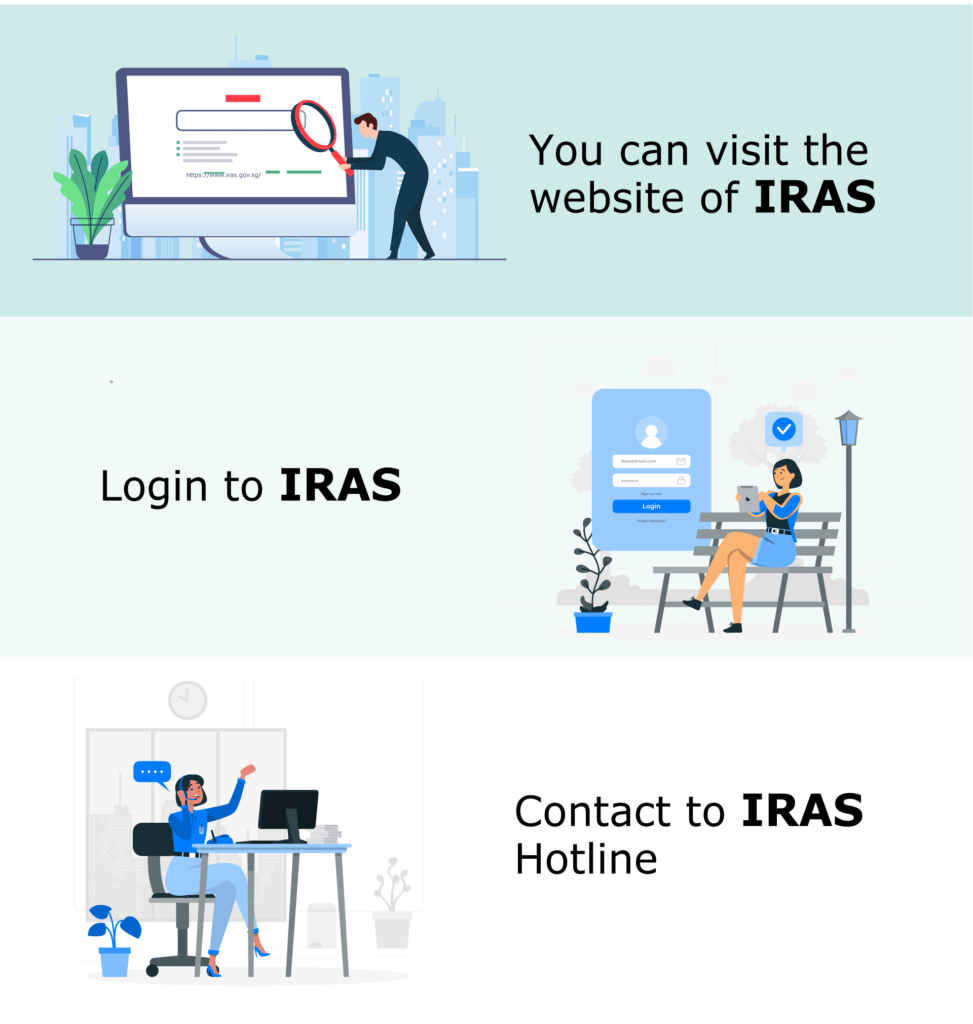
IRAS, with its digital accessibility, has made it easier for individuals and companies to contact the regulatory body.
- You can visit the website of IRAS
- Log in to IRAS
- Contact the IRAS hotline
As IRAS is making technical progress along with the digital age, the user can always approach the Virtual Assistant “Ask Jamie”, who appears in the right corner of the IRAS website for assistance and is designed to further ease the process of interaction with the taxpayers.
COMPLIANCE REQUIREMENTS OF IRAS FOR COMPANIES IN SINGAPORE
There are some mandatory requirements for companies to stay compliant with the Inland Revenue Authority of Singapore. These are the requirements one must meet to comply with the IRAS:
- Each company must submit an ECI for the YA within 3 months as soon as the financial year ends. An Estimated Chargeable Income (ECI) is an estimate of the company’s chargeable remuneration for a Year of Assessment (YA). The company must file an ECI regardless of the income. The company will file a ‘NIL’ ECI in case of zero income.
- It is mandatory for all Singapore companies to prepare Accounting Records, which must comprise a Profit & Loss Account, Balance Sheet, Cash Flow Statement and Equity Statement, which is in accordance with the Singapore Financial Reporting Standard (SFRS). The accounting records must be kept for years.
- Tax returns must be filed, too. The deadline for filing the corporate income tax return is 30 November. Documents to be submitted are an audited or unaudited Report and tax computation (Form C).
- It is mandatory for each company to submit a Financial Report. The report must consist of financial statements such as a balance sheet and income statements, supporting notes and disclosure of significant accounting policies applied by the company, disclosure of the company’s operations, and shareholders’ and directors’ interests.
- If a Company has a corporate shareholder, sales turnover that exceeds S$5 million, or it has more than 20 shareholders, then it must submit an audited report.
What is the Auto-Inclusion Scheme (AIS) in IRAS?
Employers can electronically transmit their employees’ employment income data to IRAS using the Auto-Inclusion Scheme (AIS) for Employment Income. The pay, allowances, bonuses, and other taxable income earned by the employee during the year are all included in this data.
Employers with five or more employees must use the AIS. However, all companies are urged to sign up for the AIS and send IRAS the employment income data electronically.
CONCLUSION
While performing its main functions as a tax advisor for the government and collecting taxes, IRAS has ensured competitive tax levels, along with making the process of tax collection easier. These measures, in turn, provided a boost to the Singaporean economy as taxes collected by the body contribute significantly to social and economic programmes of the country. IRAS, with its digital access, has brought ease to the burden of tax reporting for companies incorporated in Singapore and for residents of the country.
Along with it, IRAS has also aided in drafting tax agreements that prevent citizens from getting taxed twice and thus help in reducing their economic burdens.
Contact us today for professional guidance.
FAQ’s
Does Singapore have IRAS?
The primary tax administrator for the government is the Inland Revenue Authority of Singapore (“IRAS”).
How many different kinds of IRAS exist?
Here are the fundamentals of self-directed, traditional, Roth, Spousal, SEP, and SIMPLE IRAS.
How do IRAS function?
You can save money for retirement tax-advantageously with an individual retirement account (IRAS). An IRAS is a financial institution-created account that enables someone to save for retirement while earning tax-free growth or on a tax-deferred basis.
Is it compulsory to comply with the Inland Revenue Authority of Singapore (IRAS)?
Yes. All Singapore private limited companies must comply with the requirements of the Inland Revenue Authority of Singapore (IRAS), failing of which the company can result in consequences. Filings are mandatory for both active and dormant companies.
What happens if a company fails to comply with IRAS requirements?
Failing to comply with the above requirements mandated by IRAS will lead to a company facing a penalty or court prosecution.