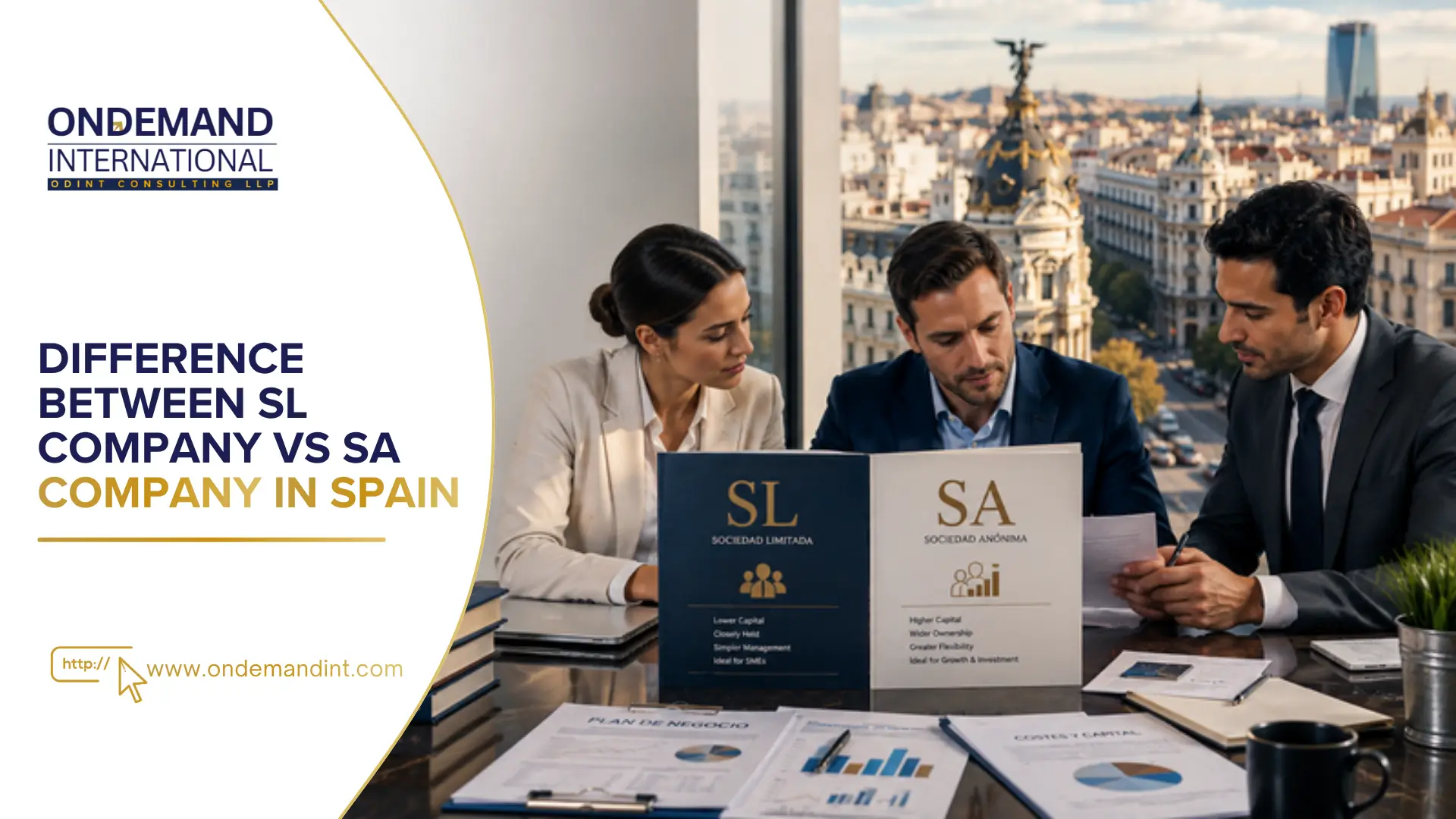
The main difference between SL company vs SA company in Spain is that an SL (Sociedad Limitada) is usually used for smaller businesses that are closely held, whereas an SA (Sociedad Anónima) is more suited to larger businesses with the need for more flexibility in relation to its share structure and access to capital.
Key takeaway: Choose an SL if you are an entrepreneur, startup, family business, or SME seeking a management and ownership structure that is simpler. An SA is typically more appropriate for larger companies that are looking for greater investment, a larger base of shareholders, or future public markets.
Selecting the proper legal form of your company when launching a new venture in Spain can impact your capital needs, ownership, management, share transfers, fundraising choices, and current administrative duties. Both are limited liability structures, although they’re used for different business situations and growth goals.
What is an SL company in Spain?
An SL company (Sociedad Limitada) is the private limited liability company of Spain. This type is commonly used by entrepreneurs and SMEs because its ownership is relatively closed and the management process can be more straightforward than an SA.
An SL may also be formed by one shareholder, which can then be run as a single-member company. Spanish company law recognises both single-member SLs and single-member SAs.
Features and benefits of an SL company in Spain
1. Limited liability protection: Shareholders are generally not personally liable for the company’s obligations beyond their contribution to the company.
2. Low minimum capital: An SL can generally be incorporated with a share capital of €1 under the current rules in Spain. The special rules are also applicable in the period before the company’s capital is increased to €3,000, such as legal reserves and the possible liability of shareholders in the event of liquidation.
3. Flexible ownership: An SL may have one or more shareholders, which makes it appropriate for individual entrepreneurs as well as small groups of business owners.
4. Closely controlled ownership: SL ownership is represented by participaciones sociales, and transfers are more restricted than the transfer of shares in an SA. Unless specific statutory provisions apply, transfers to people outside the existing ownership structure can be subject to legal restrictions and company approval.
5. Suitable for SMEs: The structure is often suitable for companies that do not require significant capital raises from many external investors.
What is an SA company in Spain?
The SA (Sociedad Anónima) is the public limited company structure in Spain. It is typically utilized by large businesses, companies with steep capital needs, and companies that want a share structure that can include a wider variety of investors.
Unlike an SL, an SA’s capital is divided into shares (acciones) rather than participaciones. Spanish company law provides specific rules governing the representation and transfer of these shares.
Features and benefits of an SA company in Spain
1. Higher capital requirement: A minimum of 25% of each share’s nominal value shall be paid at incorporation; the remainder shall be paid in accordance with the rules.
2. Share-based ownership: The company’s capital is divided into shares, making the structure more suitable for businesses that expect changes in ownership or additional investment.
3. Greater fundraising potential: An SA can be appropriate for businesses seeking significant external investment because its share structure can accommodate a larger number of investors.
4. Limited liability protection: As with an SL, shareholders generally benefit from limited liability and are not personally responsible for the company’s debts simply because they are shareholders.
5. More formal governance: An SA generally involves more formal corporate governance and administrative requirements than an SL, making it more appropriate for larger or more complex organisations.
6. Suitable for larger businesses: The structure can be useful for companies planning substantial expansion, institutional investment, or a more complex ownership structure.
Difference between SL company vs SA company in Spain
Although both structures provide limited liability protection, their practical differences become important when deciding how to establish and grow a business in Spain.
| Aspect | SL Company (Sociedad Limitada) | SA Company (Sociedad Anónima) |
|---|---|---|
| Minimum capital | €1, subject to special rules below €3,000 | €60,000 |
| Capital divided into | Participaciones sociales | Shares (acciones) |
| Liability | Limited to shareholders’ contribution | Limited to shareholders’ contribution |
| Ownership | Usually more closely held | More suitable for wider investor participation |
| Transfer of ownership | More restricted | Generally more flexible |
| Management | Generally simpler | More formal |
| Ideal for | SMEs, startups, family businesses | Larger companies and capital-intensive businesses |
| External investment | Suitable for private investment | Better suited to larger-scale fundraising |
| Complexity | Lower | Higher |
| Public market potential | Not designed for stock-market trading | Can be structured for access to public markets, subject to applicable requirements |
The distinction between participaciones in an SL and acciones in an SA is particularly important. Spanish law places specific restrictions on transfers of SL participaciones, while SA shares follow a different transfer framework.
Which is better: SL or SA in Spain?
For most entrepreneurs starting a small or medium-sized business, an SL is generally the more practical option because of its lower capital requirement, closely controlled ownership structure, and relatively straightforward management.
An SA may be more appropriate when the business requires substantial capital, expects a wider investor base, or has plans for significant expansion and a more sophisticated corporate structure.
For example:
- Choose an SL if you are starting a consultancy, technology company, family business, trading company, or other SME with a small number of shareholders.
- Consider an SA if you are building a larger company that expects substantial investment, multiple investors, or a more complex ownership structure.
- For a single founder, an SL can provide a practical corporate structure while maintaining limited liability.
- For a capital-intensive business, an SA may provide greater flexibility for attracting investors through its share structure.
The right choice ultimately depends on the company’s expected size, number of shareholders, funding requirements, ownership plans, and long-term growth strategy.
Conclusion
The choice between an SL and an SA company in Spain mainly depends on your business size, capital requirements, ownership structure, and growth plans. An SL is generally better suited to entrepreneurs, startups, SMEs, and closely held businesses, while an SA can be a better fit for larger companies seeking significant investment or a broader shareholder structure. Both provide limited liability protection, but their capital requirements, ownership rules, transfer restrictions, and governance requirements are different.
If you need help choosing between an SL and SA company in Spain, OnDemand International can help you assess your business requirements and support you with company incorporation, documentation, registration, and ongoing compliance. Contact our Spain business experts for tailored guidance on setting up the right company structure for your business.
FAQ’s
What is the difference between SL company vs SA company in Spain?
A Sociedad Limitada is generally suited to SMEs and closely held businesses, while a Sociedad Anónima is better suited to larger companies and wider investment.
What is the minimum capital for an SL in Spain?
An SL can generally be incorporated with €1, subject to special rules while capital remains below €3,000.
What is the minimum capital for an SA in Spain?
An SA requires €60,000, with at least 25% paid at incorporation.