

Introduction
Most companies don’t struggle to apply for an S Pass in Singapore.
They struggle to get it approved.
Because the S Pass is not just a mid-skilled work permit — it is a quota-controlled, compliance-driven hiring mechanism governed by the Ministry of Manpower Singapore.
And this is where most businesses get it wrong.
They assume:
- If the salary meets the threshold, approval will follow
- If the candidate is qualified, the pass will be granted
- If the company is incorporated, hiring is straightforward
None of these assumptions hold under regulatory scrutiny.
In reality, MOM evaluates far more than the application itself. It assesses:
- Whether your company has sufficient S Pass quota availability
- Whether your workforce composition aligns with local hiring expectations
- Whether the role and salary are commercially justified
- Whether your business demonstrates operational credibility and compliance readiness
In practical terms, the S Pass is not an entry route.
It is a filter that determines whether your company is structured correctly to hire mid-skilled foreign talent in Singapore.
For foreign founders and expanding businesses in Singapore, understanding this distinction early is critical — because most S Pass rejections are not application errors.
What is S Pass Singapore?
The S Pass is a type of work visa in Singapore designed for mid-level skilled foreign employees, such as technicians and professionals with advanced expertise in sectors like chemicals, electronics, aerospace engineering, marine, pharmaceuticals, and other specialized industries. This pass is typically valid for up to 2 years and can be renewed, subject to eligibility.
While Singapore offers both Employment Pass (EP) and S Pass options for foreign workers, the S Pass is often preferred by companies with limited salary budgets, as it requires a lower minimum salary threshold compared to the Employment Pass.
To qualify for an S Pass in Singapore, applicants must earn a fixed monthly salary of at least SGD $3,300 for most sectors, or SGD $3,800 if working in financial services. These are the current thresholds effective from September 2025. Salary requirements increase progressively with the candidate’s age — a candidate in their mid-40s may need to earn SGD $4,800 or more to qualify.
Only employers or authorized employment agents can apply for an S Pass on behalf of candidates. If the S Pass holder changes jobs, the new employer must reapply for a fresh S Pass. All employers are also required to provide mandatory medical insurance for S Pass holders.
Companies in Singapore must comply with a quota system and pay a foreign worker levy for S Pass holders. Due to these restrictions, obtaining an S Pass quota can be competitive and challenging.
Read More: Employment Pass in Singapore
Eligibility Criteria For S Pass in Singapore

The S pass is only for skilled foreign employees who qualify for the following criteria.
- Job offer: Must have a confirmed employment offer in Singapore.
- Singapore S Pass Salary Requirement (Most Sectors): The current minimum qualifying salary is S$3,300/month as of September 2025. For older and more experienced candidates (mid-40s and above), the salary requirement rises to approximately S$4,800/month. From January 2027, this base will increase further to S$3,600/month.
- Singapore S Pass Salary Requirement (Financial Services): The minimum qualifying salary is S$3,800/month. For senior or experienced candidates, requirements can reach S$5,650/month or higher depending on age. This will rise to S$4,000/month from January 2027.
- Qualifications (optional to declare): If you declare diplomas/degrees/technical certificates, they must be authentic, from accredited institutions, and supported by relevant experience.
- Upcoming 2027 increase: MOM has announced that S Pass minimum salaries will rise to S$3,600/month (most sectors) and S$4,000/month (financial services) effective January 2027 for new applications. Plan your hiring budgets accordingly.
Required Qualifications for S Pass Singapore
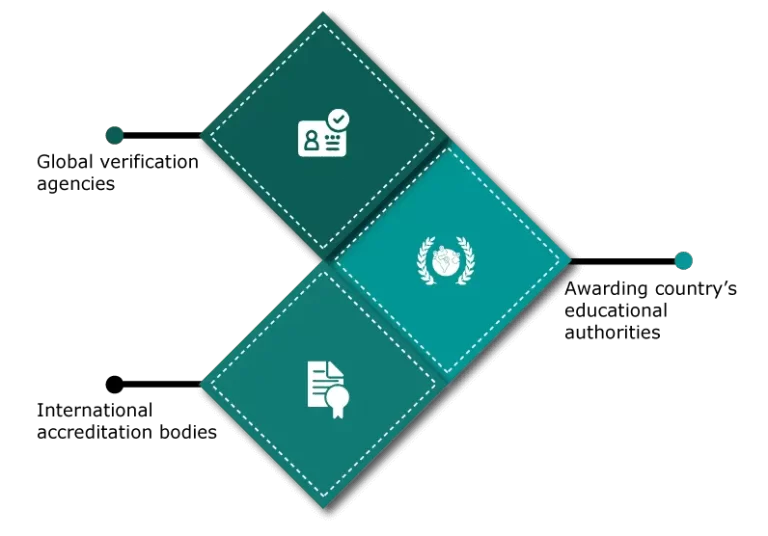
Qualifications from unaccredited institutions are not acceptable. You can contact these agencies for checking whether the institute is unaccredited or accredited-
- Global verification agencies
- Awarding country’s educational authorities
- International accreditation bodies
There are three types of accrediting bodies:
- Regional
- National
- Programmatic
Each of the accredited institutes maintains standards in that area. Seven regional bodies approve the four-year public and private institutions.
Self-Assessment Tool (SAT) — Pre-Application Check
Before submitting an S Pass application, employers should use the Self-Assessment Tool (SAT) provided by the Ministry of Manpower Singapore to evaluate preliminary eligibility.
What It Does?
- Provides an initial indication of whether the candidate may qualify for an S Pass
- Assesses factors such as salary, qualifications, and role alignment
What It Does NOT Do?
- Does not guarantee approval
- Does not assess company-level risks such as quota availability, workforce composition, or employer credibility
How to Use It Strategically?
- If the SAT indicates ineligibility → applying anyway will almost certainly result in rejection
- If the SAT indicates eligibility → it improves probability, but final approval depends on full MOM evaluation
Family members pass
S Pass holders who earn a fixed monthly salary of at least SGD $6,000 may apply for a Dependant’s Pass for their spouse and unmarried children under 21. The family pass application can be submitted together with the S Pass application or separately at a later date.
Note: This salary threshold is strictly enforced — holders earning below this amount are not eligible to bring dependants.
S Pass Quota Requirements 2026
S Pass hiring is strictly controlled by quota, linked to your company’s local workforce size.
- Employers can only hire a limited percentage of S Pass holders relative to their Singaporean employees.
- Exceeding this ratio results in automatic ineligibility for new or renewed S Pass applications.
Example: If your company in the services sector has 20 local employees (Singapore Citizens and PRs) each earning above the LQS, your maximum S Pass headcount is 2 workers (10% quota).
If 5 of those employees earn below S$1,800/month after July 2026, your qualifying local workforce drops to 15, and your S Pass quota reduces to 1. Use MOM’s quota calculator at mom.gov.sg to check your exact allowance before applying.
S Pass Levy Rates
The S Pass levy is a pricing mechanism enforced by the Ministry of Manpower Singapore to regulate foreign workforce dependency.
All employers hiring S Pass holders must pay a monthly levy, starting from pass issuance until cancellation or expiry.
Levy rates vary based on sector and quota utilisation:
- The S Pass levy has been standardised to a flat rate of SGD $650/month per S Pass holder as of September 2025, applicable across all sectors. The previous two-tier structure has been removed.
- Above quota threshold (where applicable): SGD 650/month
Higher reliance on foreign workers results in higher levy costs, making workforce composition a key planning factor for employers.
Penalty for not paying the levy
When the employer does not pay the full levy, then he will be liable for the following penalties:
- Late payment is charged with 2% per month or $20, whichever is higher, as a penalty.
- The existing S-Pass is revoked.
- New issues or renewing of S-Pass are not allowed.
Legal actions may be taken to recover the unpaid amount. And others.
How Long Does S Pass Approval Take?
Standard S Pass processing takes approximately 10 business days for straightforward cases. Complex applications — including those requiring manual review, quota verification, or additional document requests — can take up to 3 weeks. MOM does not notify applicants when a case is flagged for manual review; employers must monitor the portal actively.
Submit renewal applications at least 6 months before expiry. Never issue an employment offer letter with a fixed start date before the pass is approved.
Medical insurance for Singapore S Pass holders
All employers are required to maintain medical insurance for all the S Pass holders until their employment period. It covers inpatient care and day surgery and also the amount of at least $15000.
Arrangements for co-payment of medical insurance
Employers have to pay the amount of medical insurance up to the following amount:
- It must not be more than 10% of the employee’s monthly salary and must be a reasonable amount.
- Its duration does not exceed 6 months.
- It is with the full consent of the employee and must be expressed in the employment contract.
Salary Payment Requirements for S Pass Holders
An employer who employs S Pass holders as their employees has to pay a salary as:
- Pay salaries in electronic form
- Start paying salaries through the electronic form from the 3rd month of issue of the S-Pass
- Maintain a record of salary payments of all employees.
Exemptions :
- When an S Pass is issued for 3 months or less than 3 months.
- The salary is for the last month of employment.
- If it is an overtime wage.
Application Procedure for S Pass Singapore
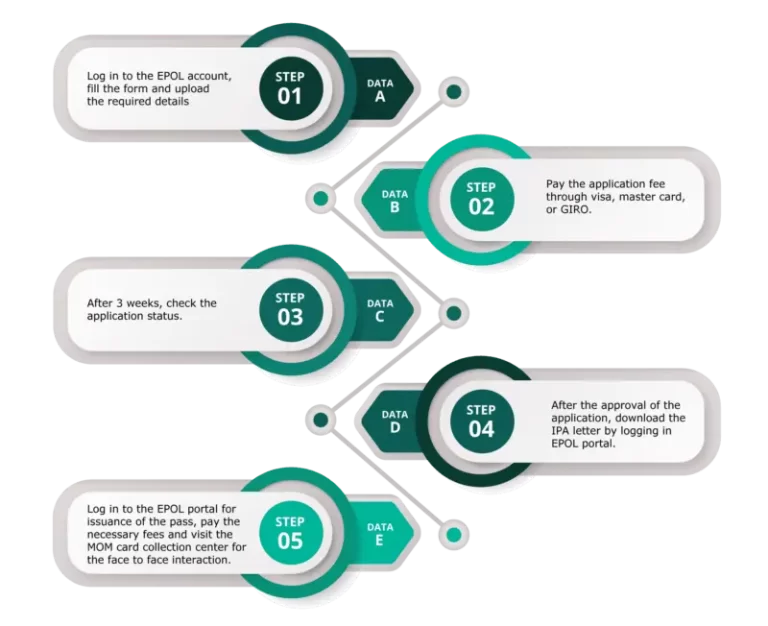
One who wants to apply for an S Pass can have access to the EPOL account for the submission of the S Pass application. We can also engage a third party or any agency to apply for the S Pass. The following steps are involved in filling out the S-Pass:
- Step 1 – Log in to the EPOL account, fill out the form, and upload the required details
- Step 2 – Pay the application fee through Visa, master card, or GIRO.
- Step 3 – After 3 weeks, check the application status.
- Step 4 – After the approval of the application, download the IPA letter by logging in to the EPOL portal.
- Step 5 – Log in to the EPOL portal for issuance of the pass, pay the necessary fees, and visit the MOM card collection centre for face-to-face interaction.
Read More: Registration Process of Singpass
Documents required for S Pass application
- Scanned copy of passport bio-data
- The latest business of sponsors company and the ACRA profile
- Educational certificates of applicants and also other required documents that are not included in the application form.
Benefits of the S Pass
For Employers
- Provides a structured and compliant route to hire mid-skilled foreign talent
- Enables businesses to bridge operational skill gaps where local hiring is insufficient
- Supports workforce scaling within a regulated quota and levy framework
For S Pass Holders
- Ability to change employers, subject to a fresh S Pass application and approval
- Eligibility to apply for Singapore Permanent Residency (PR) over time (not guaranteed)
- Option to sponsor dependants, subject to meeting minimum salary thresholds
Structural Advantages
- Fewer job scope restrictions compared to Work Permit categories
- Positioned between Work Permit and Employment Pass, offering greater flexibility and upward mobility
- Provides a clearer long-term pathway for skilled professionals working in Singapore
When S Pass Applications Get Rejected?
S Pass rejections are rarely random. They are structural.
The most common failure points include:
1. No quota availability
Employers exceed the allowed S Pass ratio based on their local workforce
2. Weak employer profile
Limited business activity, low revenue visibility, or lack of operational substance
3. Salary misalignment
Compensation that does not match role expectations, industry benchmarks, or candidate experience
4. Insufficient local hiring
Lack of Singaporean workforce signals poor alignment with national employment priorities
How to appeal against the application of rejected the S Pass?
One can apply against the rejection of the S Pass application within 3 months of rejection. One should mention the issue with the rejection advisory.
The employers and the third party who had applied for the S-Pass can make inquiries and appeals. The candidate cannot make any appeal or enquire.
After appealing, one can check their application status by logging in to the EPOL portal. The appeal can take at least 3 weeks in most cases, but in some cases, it takes longer than that.
How to renew the S Pass?
Employers and appointed employment agents can renew their S-Pass by applying 6 months before its expiry. In most cases, it takes 3 weeks to renew an S-Pass. It costs $100 per renewal in Singapore.
For renewing the S Pass in Singapore, the employer should:
- Qualify for the existing eligibility criteria
- 7 months’ validity of the passport of the passport holder.
- Have sufficient s pass quota.
S Pass vs Employment Pass — When to Choose What
Choosing between an S Pass and an Employment Pass is not a cost decision — it is a structural decision.
Choose S Pass when:
- The role is mid-skilled
- Salary falls within S Pass thresholds
- The company has available quota capacity
- Workforce composition supports foreign hiring
Choose Employment Pass when:
- The role is managerial or professional
- Salary meets higher EP benchmarks
- The company lacks S Pass quota
- The hire is strategic or leadership-driven
Conclusion
The S Pass in Singapore is a vital gateway for skilled foreign professionals seeking mid-level employment opportunities in one of Asia’s most vibrant economies. From eligibility requirements and quota restrictions to salary obligations and levy payments, navigating the S Pass system requires a clear understanding of the Ministry of Manpower’s guidelines.
Whether you’re an aspiring candidate or an employer looking to expand your workforce, staying compliant with the latest regulations is crucial. While the application process may seem complex, the S Pass offers significant advantages, including the possibility of family relocation and long-term residency options.
Looking for expert guidance on the S Pass Singapore application process? Contact Ondemand international support to ensure full MOM compliance, faster approvals, and a seamless experience for both employers and professionals.
FAQ’s
What is the S Pass quota for my company in 2026?
Your S Pass quota depends on your sector and the number of local employees (Singapore Citizens and PRs) earning above the Local Qualifying Salary (LQS) of S$1,600/month (rising to S$1,800 from July 2026).
For the services sector, the cap is 10% of your qualifying local workforce. For manufacturing, the cap is higher. Use MOM’s quota calculator to check your exact allowance before submitting any application.
How long does S Pass approval take in 2026?
Standard S Pass processing takes approximately 10 business days.
Cases flagged for manual review — due to quota issues, salary queries, or employer compliance history — can take up to 3 weeks or longer. MOM does not alert you when a case enters manual review.
Employers should submit applications well in advance and monitor the myMOM Portal regularly.
Can an S Pass holder be converted to an Employment Pass?
Yes, an S Pass holder can transition to an Employment Pass if they meet EP eligibility criteria — primarily the minimum salary of S$5,600/month (most sectors) and pass the COMPASS assessment.
The employer must submit a fresh EP application. The S Pass must remain valid during this process. There is no direct conversion — the EP is treated as a new application.
Can an S-Pass holder change his job?
Yes, an S-Pass holder can change his job, but he is required to ask his new employer for a new S-Pass.
What are the most common reasons for S Pass rejection?
The most common rejection reasons are:
(1) Insufficient S Pass quota relative to local headcount;
(2) Salary below the age-appropriate benchmark even if above the minimum floor;
(3) Poor employer compliance history or low business activity; (4) Educational qualifications from unaccredited institutions; and
(5) Role mismatch — the job scope does not align with the candidate’s experience level. MOM rarely gives specific rejection reasons, making quota and salary alignment critical before applying.