
Choosing the best bank in Singapore for foreigners in 2026 depends on balancing low international transfer fees, multi-currency support, and ease of remote account opening. While the "Big Three" (DBS, OCBC, and UOB) offer the most robust local infrastructure, global players like HSBC and Standard Chartered are often preferred for seamless cross-border wealth management.
For non-residents, digital-first options and professional incorporation services now provide the fastest route to a fully operational Singaporean business account.
Introduction
Whether you are a business owner incorporating your first startup or expanding an existing business, choosing the best bank in Singapore can define how efficiently your money moves across borders. Additionally, the top banks in Singapore provide alluring incentives, including credit cards, international money transfers without restrictions, multi-currency accounts, trade finance, and more.
Through this article, we will tell you everything you need to know about choosing the bank that fits the non-resident Singaporean’s requirements, and we will further list out the 7 best banks in Singapore for foreigners.
Banking Services Needed by Foreigners in Singapore
If you’re a non-resident who is considering registering a company in Singapore, then opening a bank account there is crucial to managing the finances of your business.
However, your banking needs will differ significantly from the needs of a citizen or a permanent resident. For one thing, you would need to send remittances back to your home country. So, you would need a bank that can make that transfer painless.
Listed below are the basic banking services that foreign individuals in Singapore would need on a continuous basis:
- Presence both in your home country and Singapore
- ATM and Savings Deposit services in both Singapore and your home country
- Low fees for both international and domestic transfers
- Low minimum balance requirements and low penalties for falling below
- Higher interest rates on Savings accounts
- Ask if your account allows you multi-currency deposits and withdrawals for travel or other urgent transfers
- Other convenience features, such as 24 by 7 branches, overdrafts, credit cards, multiple transfer options, club memberships, etc.
Singapore’s Financial Structure
Singapore’s banking system is designed to accommodate a range of banks and financial organizations.
These are the main categories of banks in Singapore’s financial system:
- Local Banks: Singapore has six local banks, such as Bank of Singapore Limited, DBS Bank LTD, etc.
- International Banks: To access Singapore’s financial sector and provide for its clients, numerous foreign banks have set up branches in the jurisdiction. These banks coexist with local banks in Singapore and add to the overall banking environment. At the moment, Singapore is home to 119 foreign commercial banks.
- Merchant Banks: Merchant banks are specialized banks with an emphasis on offering business financing and advising services in Singapore.
- Offshore Banks: Singapore serves as a significant centre for offshore banking operations. Offering services to foreigners and overseas businesses, offshore banks frequently concentrate on wealth management, tax planning, and asset protection.
- Wholesale Banks: These banks prioritize serving corporate customers, institutional investors, and other financial organizations. Approximately 54 wholesale banks are present in Singapore.
Documents Required for Opening an Account in Singapore Banks
The following document list is meant for online bank account opening applications and is only valid for Singapore citizens, PRs, Employment/S-Pass holders, Students on a visa, Entre pass holders, etc. Further, the information here is valid at the time of writing and may be subject to change periodically.
- Identity Card/Employment Pass/S Pass/Student Visa/Entre Pass
- Address of Residence, either local or overseas – the latter address to be accepted on a temporary basis till you find a local address and inform the bank through their digital platform.
- Employment proof: Work passes in Singapore issued by Singapore’s Ministry of Manpower usually suffice as proof of employment.
Need help opening a business account in Singapore? Talk to our experts
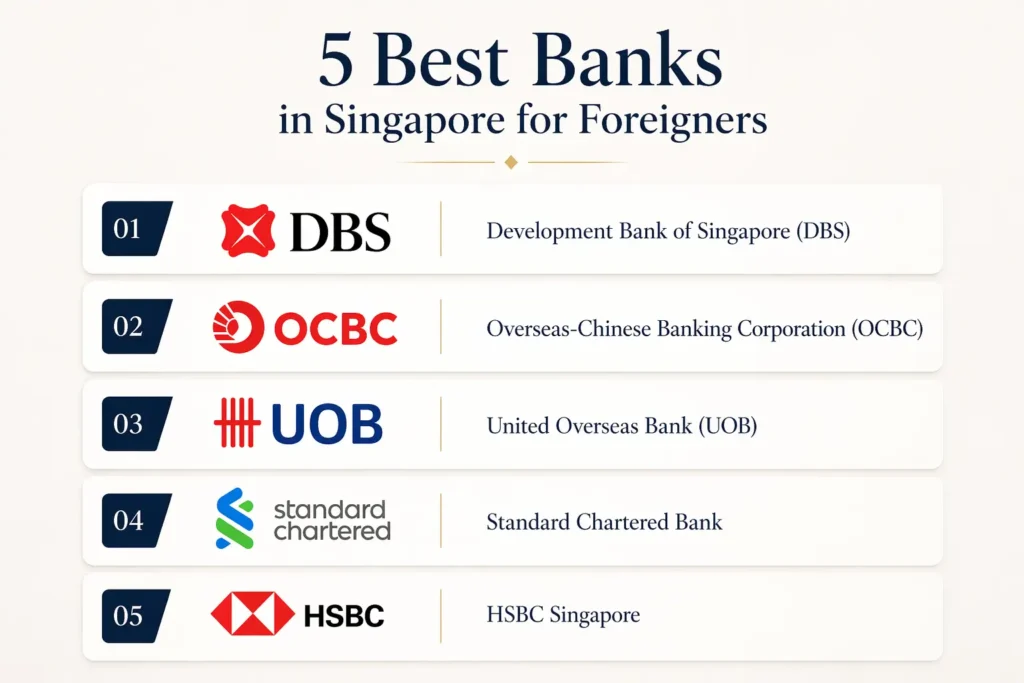
5 Best Banks in Singapore for Foreigners
Some of the best banks in Singapore for foreigners are discussed below:
1. Development Bank of Singapore (DBS)
- With 50+ years of heritage behind them and S$ 646 billion in total assets, DBS is easily one of Singapore’s largest and most recognizable banks.
- DBS has a presence in some of the biggest markets globally, including Los Angeles, London, Beijing, Mumbai, Penang, Jakarta, Seoul, and many others.
- This bank is known for its paperless account opening and digital services at very economical rates.
- At the time of writing, DBS had 250 branches globally, while it claimed to have the largest network of ATMs in Singapore.
2. Overseas-Chinese Banking Corporation (OCBC)
- OCBC is one of the oldest and largest banks in Southeast Asia.
- It is one of the best banks in Singapore as it owns 570+ branches in 18 regions and countries worldwide.
- It has a major presence in Malaysia, Indonesia, Singapore, and China.
- OCBC has successful interests in Singapore’s insurance and capital markets and serves personal banking customers as well as small to medium-sized businesses.
- OCBC (Oversea-Chinese Banking Corporation) offers a debit card that provides customers with the benefit of no foreign currency transaction fees and a zero-dollar fall-below fee. These features enhance the convenience and cost-effectiveness of using the OCBC debit card for international transactions.
3. United Overseas Bank (UOB)
- United Overseas Bank is the 3rd largest bank in Singapore.
- UOB has seen its asset portfolio grow consistently in recent years with a steady cost-to-income ratio.
- This bank currently has 68 branches in Singapore alone and has marked its presence in 19 countries worldwide, including Australia, the UK, the US, India, & Canada, apart from almost all of Singapore’s neighbours and India.
- Known for its strong service support to SMEs.
- It has over 500 offices across 19 countries worldwide
- It also grants users up to 2.5% interest per annum
4. Standard Chartered Bank
- Standard Chartered, with origins in the UK, has been a major player in Singapore since 1859.
- Part of a global banking group, its Singapore HQ offers one of the most diverse portfolios of products and services in the industry.
- Presently has 12 branches and 25 ATMs in Singapore, with 4 Priority Service branches and 1 high-end International Banking & Priority Service branch.
- Custodian banker of choice for foreign institutions in Singapore, having won numerous international banking awards.
5. HSBC Singapore
- Like Standard Chartered, HSBC opened a branch in Singapore in the second half of the 19th century.
- Is an authorized Primary Dealer of G-secs and other foreign corporate bonds in Singapore.
- This bank is also part of an international group with branches in several countries, including India, the US, the UK, Australia, and many others.
- Branch visits are necessary for account opening at HSBC Singapore.
Our experts from OnDemand International can assist you in opening a physical bank account in banks like HSBC and ICICI, and can also assist you open a virtual bank account in Wise or Aspire.
5 Best Banks In Singapore For Foreigners Compared
| Bank | Type | Min. Balance | Online Opening | Multi-Currency |
|---|---|---|---|---|
| DBS Bank | Local | S$3,000 | ✓ Yes (with SingPass) | ✓ Yes |
| OCBC | Local | S$1,000 | ✓ Yes | ✓ Yes |
| UOB | Local | S$1,000 | ⚬ Partial | ✓ Yes |
| Standard Chartered | Foreign | S$200,000 | No Branch visit required | ✓ Yes |
| HSBC | Foreign | S$200,000 | No Branch visit required | ✓ Yes |
Time taken to open a bank account for a Foreigner
For most banks, it takes between 3 and 7 working days to have a fully functional bank account opened.
DBS commits to 3 business days. However, SingPass holders may be eligible for instant account opening.
Why Work With OnDemand International Instead of Going Directly to the Bank?
Opening a bank account in Singapore as a non-resident is rarely as straightforward as walking into a branch. Most banks require SingPass, a local address, in-person verification, and a registered company — all of which need to be in place before your application is even considered. This is where OnDemand International steps in.
We handle the entire process remotely: from incorporating your Singapore company to preparing the right documentation and liaising with the bank on your behalf.
Instead of spending weeks navigating bureaucratic back-and-forth across time zones, our clients typically have a fully operational Singapore business account set up in a fraction of the time.
Whether you’re based in India, the UAE, Europe, or anywhere else in the world, you don’t need to fly to Singapore to get started — we bring Singapore to you.
Stay Compliant in Every Market
You Operate In.
On Demand International helps companies manage corporate compliance across borders — entity registration, statutory filings, tax and regulatory reporting — in over 100 countries, so global businesses can expand without compliance risk.
Conclusion
There are numerous best banks in Singapore for foreigners, such as OCBC, DBS, Standard Chartered Bank and so on. While opening a bank account in one of the best banks, you must, however, consider numerous factors, including the services offered, accessibility, customer service, prices for the services, card availability, international money transfer capabilities, and so forth.
If you’re an entrepreneur looking to establish a bank account and launch a business in Singapore, you can arrange a free consultation with our experts from OnDemand International. We can help you register your business and open a Singaporean bank account, either online or offline.
FAQ’s
Can a foreigner open a bank account in Singapore?
Yes, foreigners can open both personal and corporate bank accounts in Singapore. However, they must provide necessary documentation such as a passport, proof of address, proof of employment (if applicable), and in some cases, an in-person verification may be required.
What documents are required for a foreigner to open a bank account in Singapore?
To open a bank account as a foreigner in Singapore, you typically need:
1. A valid passport
2. Proof of residence (either in Singapore or overseas)
3. Employment Pass, S Pass, Student Visa, or Dependant Pass (if applicable)
4. Proof of employment (for salaried individuals)
5. Business incorporation documents (for corporate bank accounts)
Which is the best bank in Singapore for international transfers?
Some of the best banks for international money transfers in Singapore include:
1. DBS Bank – Offers competitive rates and digital banking services.
2. Standard Chartered Bank – No fees on certain foreign exchange transactions.
3. CitiBank – Strong global presence and multi-currency account options.
4. HSBC – Offers an integrated global banking experience.
5. Wise (formerly TransferWise) – A fintech alternative for low-cost, real-time international transfers.
Do I need to be physically present in Singapore to open a bank account?
For most traditional banks like DBS, OCBC, UOB, and HSBC, a physical visit to the bank is usually required. However, some digital banking options like Wise, Aspire, and Revolut allow foreigners to open accounts remotely.
What should I consider before choosing a bank in Singapore as a foreigner?
Before opening a bank account in Singapore, consider the following:
1. International money transfer fees and exchange rates.
2. Minimum balance and maintenance fees.
3. Availability of multi-currency accounts.
4. Online and mobile banking features.
5. Branch and ATM accessibility in your home country.